




#UkraineEverywhere is the motto of the annual international information campaign entitled Ukraine’s Cultural Diplomacy Month on Wikipedia. The campaign is designed to create more articles about Ukraine and its culture in foreign languages on Wikipedia.
Ukraine’s Cultural Diplomacy Month on Wikipedia is dedicated to prominent Ukrainian artists, significant cultural phenomena, and events that are part of the world’s cultural heritage and deserve to be represented on Wikipedia. The campaign encourages contributors to the online encyclopaedia to expand existing articles and create new ones in foreign languages, making reliable information about Ukraine accessible to audiences around the world.
The project is organised by the Ukrainian Institute, Wikimedia Ukraine, and the Ministry of Foreign Affairs of Ukraine, with the Global Coalition of Ukrainian Studies serving as the strategic partner.
From 1 to 30 April, the annual information campaign Ukraine’s Cultural Diplomacy Month on Wikipedia was held for the sixth time. The campaign was organised by the Ukrainian Institute, the Ministry of Foreign Affairs of Ukraine, the NGO Wikimedia Ukraine, and the Global Coalition of Ukrainian Studies.
Results:
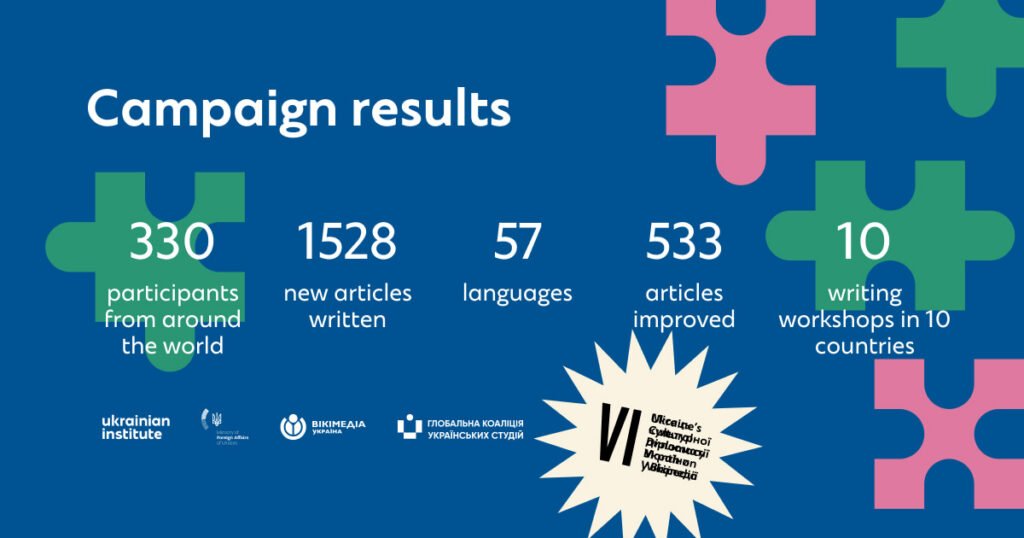
Throughout the month, 330 participants from around the world joined the campaign, including 284 first-time participants. This is the highest level of participation in the campaign’s history. Together, they created 1 528 new articles and improved 533 existing ones on Wikipedia in 57 languages. Additionally, 10 Wikipedia writing workshops were organised across 10 countries in collaboration with Ukrainian diplomatic missions, universities, and global Wikimedia communities.
This year, participants most actively translated articles about historical figures and prominent representatives of Ukrainian culture, Ukrainian cuisine, contemporary cinema, and Ukrainian folk traditions.
Among the newly created articles were articles about Bohdan Stupka in Azerbaijani, Ukrainian folk tales in Bengali, the monument to Volodymyr the Great in Georgian, palianytsia in Greek, the didukh in Odia, Panteleimon Kulish in Portuguese, Sviatoslav Vakarchuk in Romanian, Liubov Panchenko in Marathi, the Valuev Circular in Spanish, and green borscht in Japanese.
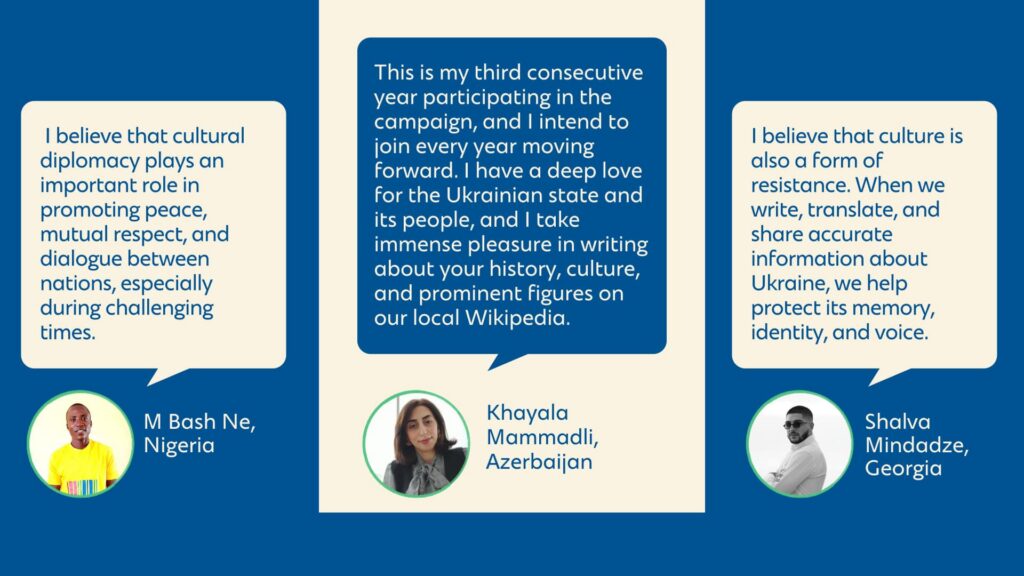
Feedback:
Anyone interested in sharing knowledge about Ukrainian culture on Wikipedia is welcome to take part in the campaign, including:
The campaign is open to participants from all countries worldwide.
Register on Wikipedia → Choose an article from the suggested list → Write/ translate an article into your language, or improve an existing one according to the platform’s rules → Add your contribution to the contest page and calculate your points → Win prizes and receive a certificate of participation → Become a promoter of truthful knowledge about Ukraine.
The campaign includes a competition component.
Participants who create or improve the most articles and achieve the highest scores receive prizes from the organisers.
Articles are evaluated according to Wikipedia’s standards, taking into account the quality of the text written in encyclopaedic style, the use of reliable sources, and the completeness of the topic.
How to register?
Register and join the campaign from 1 to 30 April.
Useful materials: Guidelines on creating and editing articles on Wikipedia
From 14 April to 16 May, the annual information campaign Ukraine’s Cultural Diplomacy Month on Wikipedia was held for the fifth time, organised by the Ukrainian Institute, the Ministry of Foreign Affairs of Ukraine, and the NGO Wikimedia Ukraine.
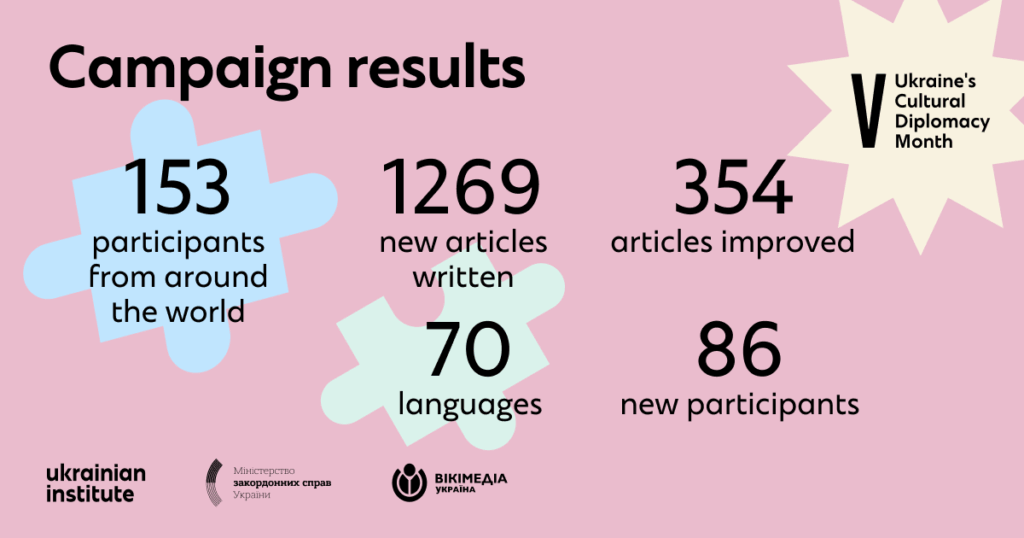
Over the course of the month, 153 participants from around the world joined the campaign, creating 1,269 new articles and improving 354 existing ones on Wikipedia in 70 languages. The communications aspect took place on the organisers’ social media channels, with the support of Diplomatic institutions.
Participants created articles about Volodymyr Sosiura in Italian, Portuguese, and Indonesian, and about Kateryna Bilokur in Spanish, Iban, and Portuguese. Many contributions also focused on Ukrainian cities, such as Kharkiv and Odesa, as well as historical landmarks like the Hlukhiv State Historical and Cultural Reserve and Shevchenkivskyi Hai.
Additionally, materials were published about the Slovo Building in Kharkiv, the United24 initiative, and Suspilne Kultura, highlighting both Ukraine’s historical legacy and its contemporary cultural diplomacy.
In March, the annual information campaign “Ukraine’s Cultural Diplomacy Month on Wikipedia,” organised by the Ukrainian Institute, the Ministry of Foreign Affairs of Ukraine, and the “Wikimedia Ukraine”, took place for the fourth time.
“I am grateful to each and every one of the more than two hundred participants from all over the world who, at our call, created and improved more than 1,500 Wikipedia articles on Ukraine. This is an important contribution to the decolonisation of Ukrainian culture and countering Russian appropriation, historical myths and propaganda. This is the fourth year in a row that we have held the Ukrainian Cultural Diplomacy Month on Wikipedia, and I am glad that the project is growing in scale year by year. Together, we are protecting Ukrainian identity from Russian attempts to destroy it,”
said Dmytro Kuleba, Minister of Foreign Affairs of Ukraine.
The project engaged 200 participants from around the world who improved 425 existing articles and created 1260 new ones on the platform. The materials were created in 66 languages, which was a record figure for the four years of the project.
Within the project, the participants wrote articles about Shevchenko’s ‘Testament’ in French, Kamianets-Podilskyi Fortress in German, St. Andrew’s Church in Arabic, the film ‘Earth’ in Chinese, and the ‘Pamphyr’ movie in Uzbek. Materials were also created about Iryna Tsilyk in Tamil, the Slovo Building in Urdu, Taras Kompanichenko in Berber, the Ukrainian national anthem in Breton, and Lesia Ukrainka in Manipuri.
The participants also paid much attention to Ukrainian intangible heritage. Now Wikipedia has articles in Assamese about Ukrainian national clothing, in Esperanto about Khortytsia island, and about historical figures and events – in Georgian about Ivan Mazepa, in Cantonese about the Ukrainian People’s Republic, and in Hungarian about Anna Yaroslavna.
In March 2023, Wikipedia hosted the Ukraine’s Cultural Diplomacy Month on Wikipedia for the third time.
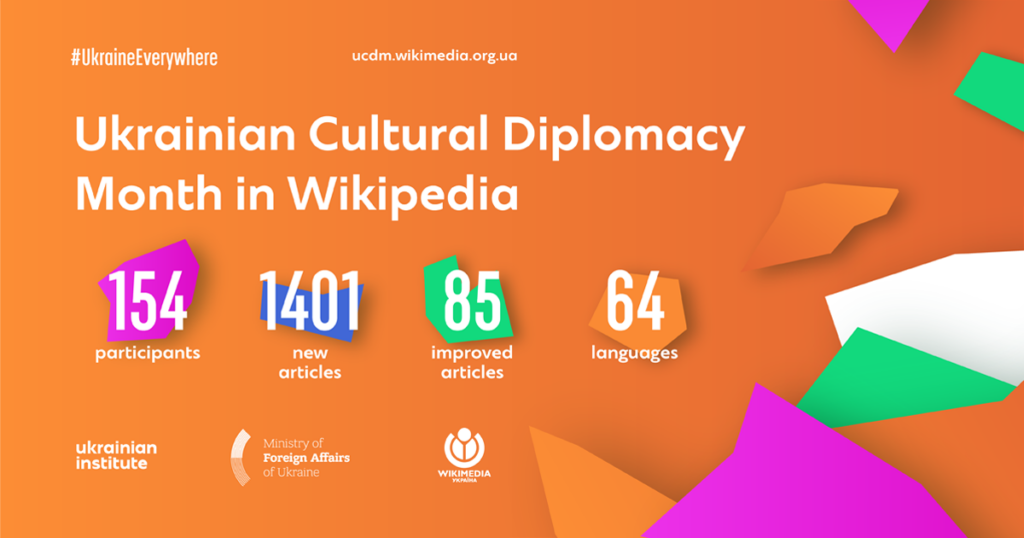
The campaign was joined by 154 participants from all over the world. They wrote 1,401 new articles and improved 85 existing ones in 64 different language sections of Wikipedia. In particular, they created articles about the phrase “Glory to Ukraine!” in Estonian, the play Natalka Poltavka in French, the films Earth and Shadows of Forgotten Ancestors in Hungarian, Ivan Marchuk in Japanese, the novel The City by Valerian Pidmohylny in Arabic, and the Kuindzhi Art Museum in Chinese.
“This is the third Ukraine’s Cultural Diplomacy Month since the Ministry of Foreign Affairs launched this initiative in 2020. The full-scale aggression of the Russian Federation not only failed to stop it, but made it even more significant. I am grateful to each and every author who has responded to our call this year, creating and improving almost 1,500 articles about Ukraine in 64 language sections. Through the joint efforts of the state and civil society, we are countering Russian propaganda and systematically updating the global information space with truthful facts about Ukraine and its culture,”
commented Dmytro Kuleba, Minister of Foreign Affairs of Ukraine.
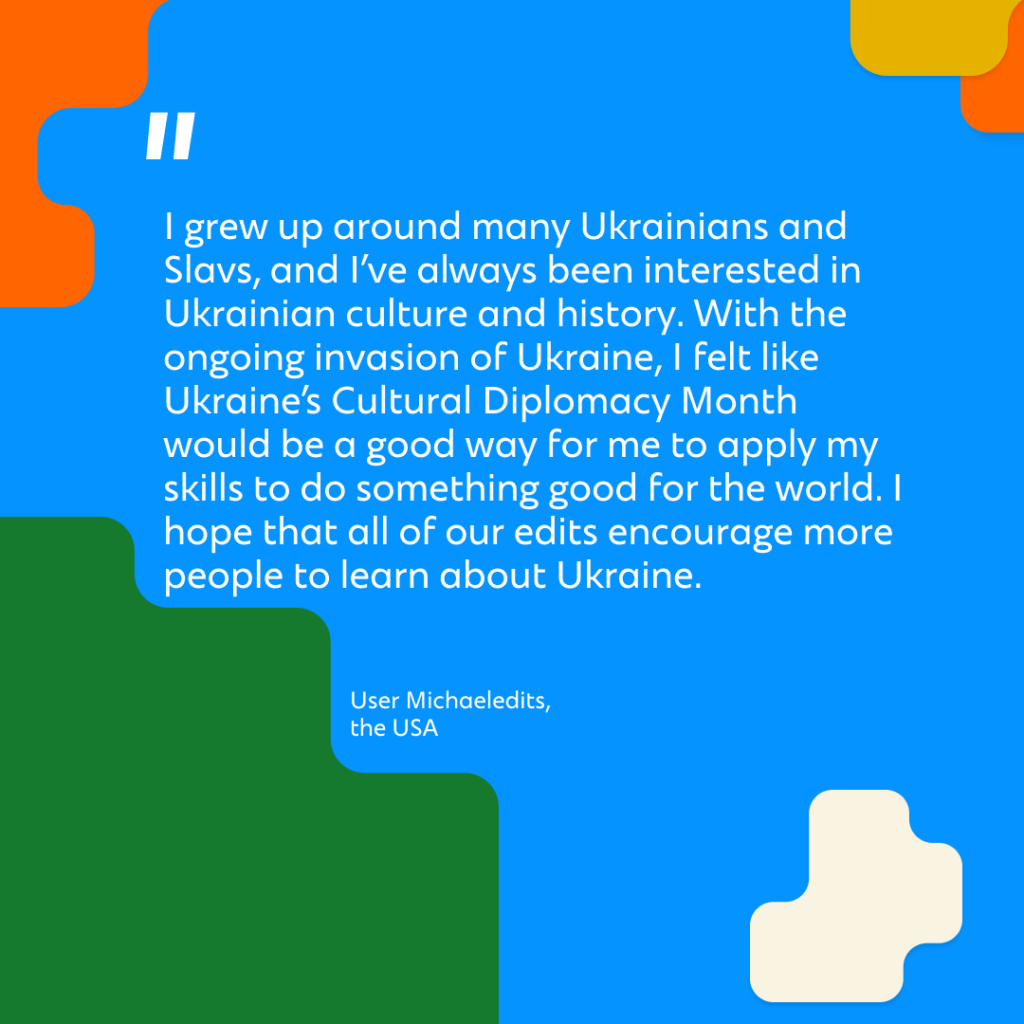
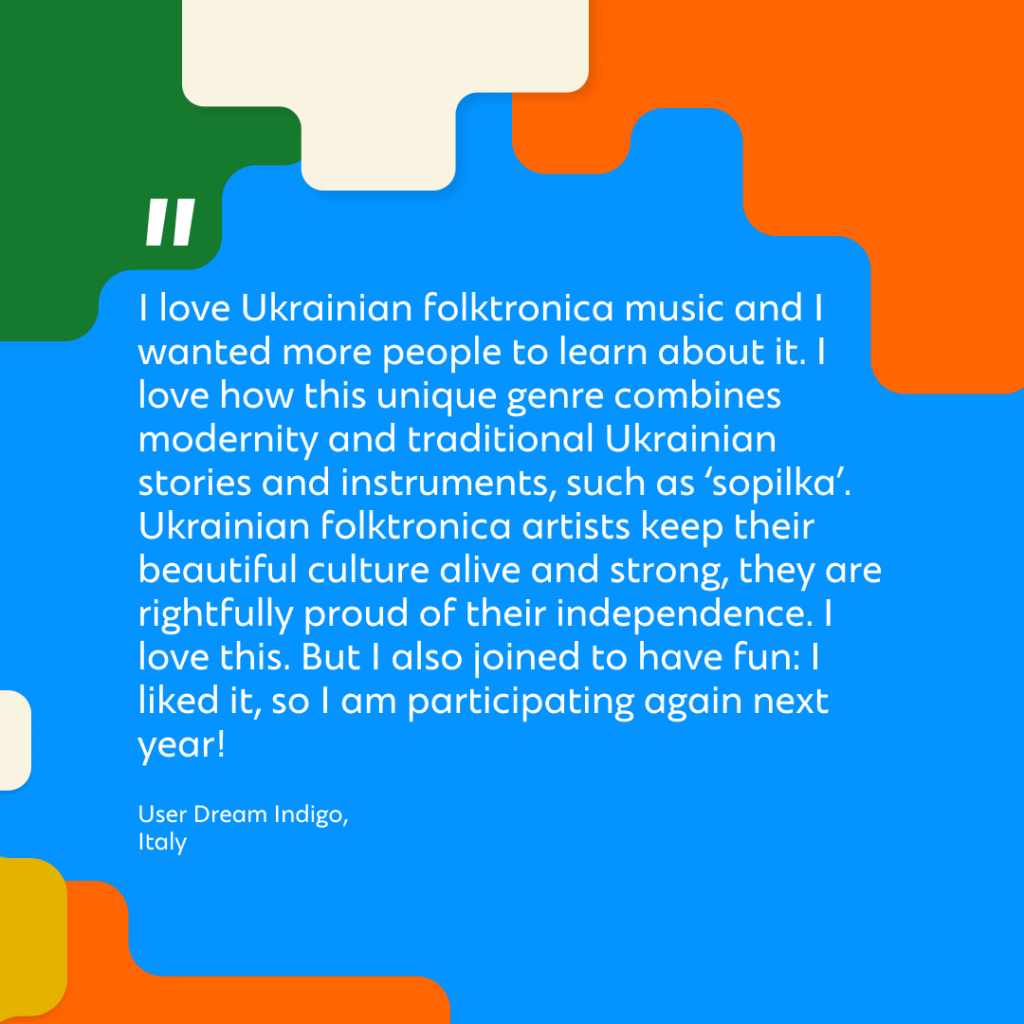
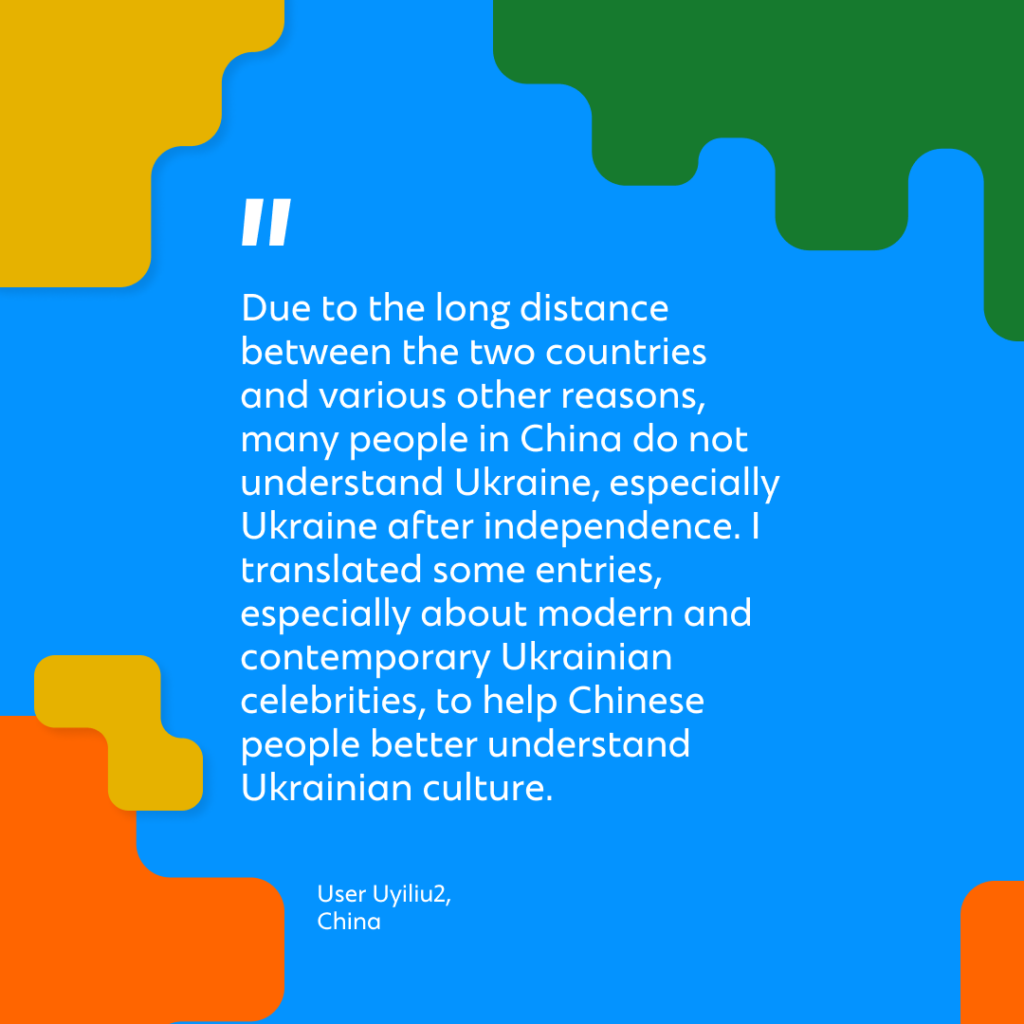
I joined your Campaign to honor my late mother. She was in Europe in mid ‘60s, and cherished the children’s book based on Ukrainian fable of a mitten hosting forest animals,”
— participant Omotecho from Japan, joined the project for the third time.
“I wanted to help Ukraine somehow. One of the ways, I figured, was by raising awareness about the depth of Ukrainian culture. This time, I focused specifically on translating articles about places of interest in Ukraine, such as museums, theaters, and opera houses. I hope the information would drive more people to visit Ukraine after the war, bringing in some tourist revenue,”
— participant Nyagoslav Zhekov from Malaysia.
In February-March 2022, Wikipedia hosted the “Ukraine’s Cultural Diplomacy Month on Wikipedia” for the second time. It was aimed at creating and improving articles about Ukraine and Ukrainian culture in as many languages as possible.
During the month of the campaign, 253 participants joined it. 29 of them took part in the marathon for the second time, 224 joined for the first time this year.
In total, they wrote 3,813 new articles and improved 262 existing ones in 60 different language sections of Wikipedia. That’s five times more than last year. In particular, articles about Pavlo Tychyna in Arabic, about Anna Yaroslavna in Finnish, a painting “Moonlit Night on the Dnieper” in Chinese, a dance “Hopak” in Persian, about the Ukrainian avant-garde in German, and a novel “Shadows of Forgotten Ancestors” in French.
There are also articles in unique languages in small language sections of Wikipedia. The article about Ukraine was published in Nahuatl, about Kyiv in Shilha, Ahatanhel Krymskyi in Central Bikol, Taras Shevchenko in Tagalog, and Yurii Vynnychuk in Bashkir.
“Thanks to this project, hundreds of new articles have appeared on Wikipedia in different languages about Ukraine, its culture, achievements and potential. People all over the world will be able to learn something new about our country. I am convinced that this will encourage many of them to later visit Ukraine, study there or invest in it. We will definitely work for the development and success of this project in the future”.
— said Dmytro Kuleba, Minister for Foreign Affairs of Ukraine.
"It is important for the Ukrainian Institute that culture becomes a unifying force and helps to build Ukraine’s ties with the world. In this project we managed once again to achieve it. Ukraine's Cultural Diplomacy Month gathered participants from dozens of countries, including experienced wiki writers interested in Ukraine as well as foreign Ukrainians, students, and university professors".
— commented Volodymyr Sheiko, Director General of the Ukrainian Institute.
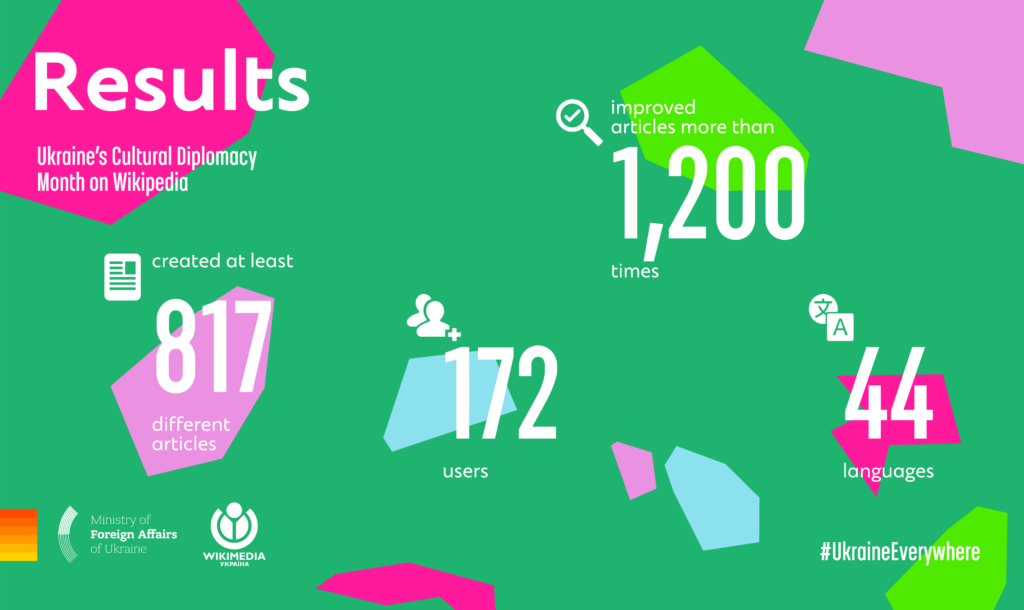
As part of #UkraineEverywhere campaign 2021, 172 users created and improved articles more than 1,200 times (several users could edit one article), and created at least 817 different articles in Ukrainian and foreign languages. Participants created articles about things we are used to in new languages: for example, articles “Mnohaya lita” and “Borsch” in Malayalam (India) and an article about “Executed Renaissance” in Chinese. Actively in many languages added articles to Wikipedia about the brand of Ukraine – Ukraine NOW; famous Ukrainian films of recent years – Atlantis, Donbass; Dzyga Vertov, Sofia Yablonska.
Portuguese, English and French became the leaders in the number of added and revised articles. The project aroused considerable interest in Asian countries. #UkraineEverywhere campaign covered 44 languages in total: Afrikaans, Arabic, Aragonese, Assamese, Azerbaijani, Bangla, Bashkir, Bengali, Bosnian, Bulgarian, Catalan, Chinese, Croatian, Dutch, Egyptian Arabic, English, Finnish, French, Galician, Georgian, German, Indonesian, Italian, Japanese, Korean, Luxembourgish, Macedonian, Malayalam, Occitan, Persian, Polish, Portuguese, Punjabi, Romanian, Russain, Serbian, Serbo-Croatian, Spanish, Swedish, Tagalog, Telugu, Ukrainian, Urdu.
The project included two webinars (in Ukrainian and English) that helped to get acquainted and better understand the writing of articles for Wikipedia. More than 150 participants joined the webinars.