
35 Pices of Ageless ProJect
Over millennia, many peoples and forms of statehood rose on this land — the Trypillian culture and the Scythians, Kyivan Rus, and the Cossack state. Ukraine is their heir. Its art carries that whole span: from ancient craft through the Cossack Baroque and the avant-garde to the art of today.
This project shows that Ukrainian art has never stood apart from the world: it took in influences and gave them back — shaping the art of Europe, and reaching beyond it, crossing continents, and bringing people together. And Ukraine has always told its own story, in its own name — a name that could not be erased and will not be.
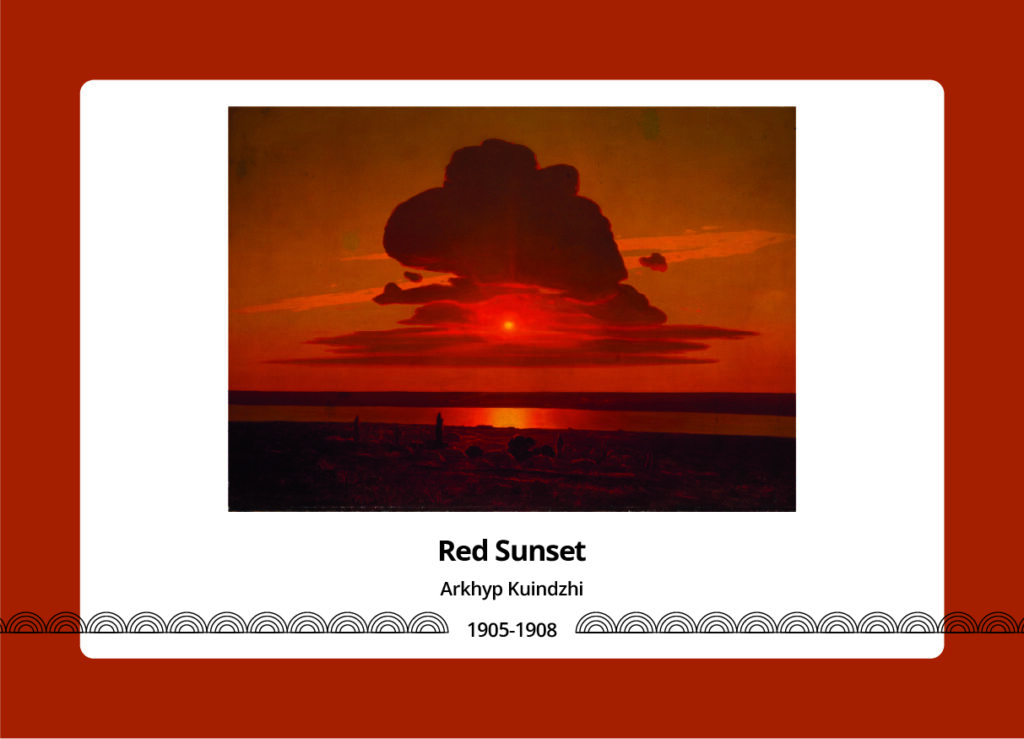
Red Sunset, Arkhyp Kuindzhi, 1905-1908
Metropolitan Museum of Arts
Born into a Greek family in Mariupil, Ukraine, Arkhyp Kuindzhi (1841-1910) became world-famous for his landscapes of the Ukrainian steppe. Studying at the St. Petersburg Imperial Art Academy, he spent most of his life in his native Ukraine – Mariupol and Crimea. “Red Sunset”, or “Red Sunset over the Dnipro River,” is now part of the collection of the Metropolitan Museum. The Dnipro is Ukraine’s main river, dividing it into two parts from the North to the Black Sea. The sketch of the painting was in the collection of Kuindzhi’s museum in Mariupil before russian invasion in February 2022. The city was besieged for a couple of months, and the museum was destroyed by the Russian army. After the occupation, Red Sunset, which survived the attack, was stolen by occupation forces. The location of this artwork is unknown.
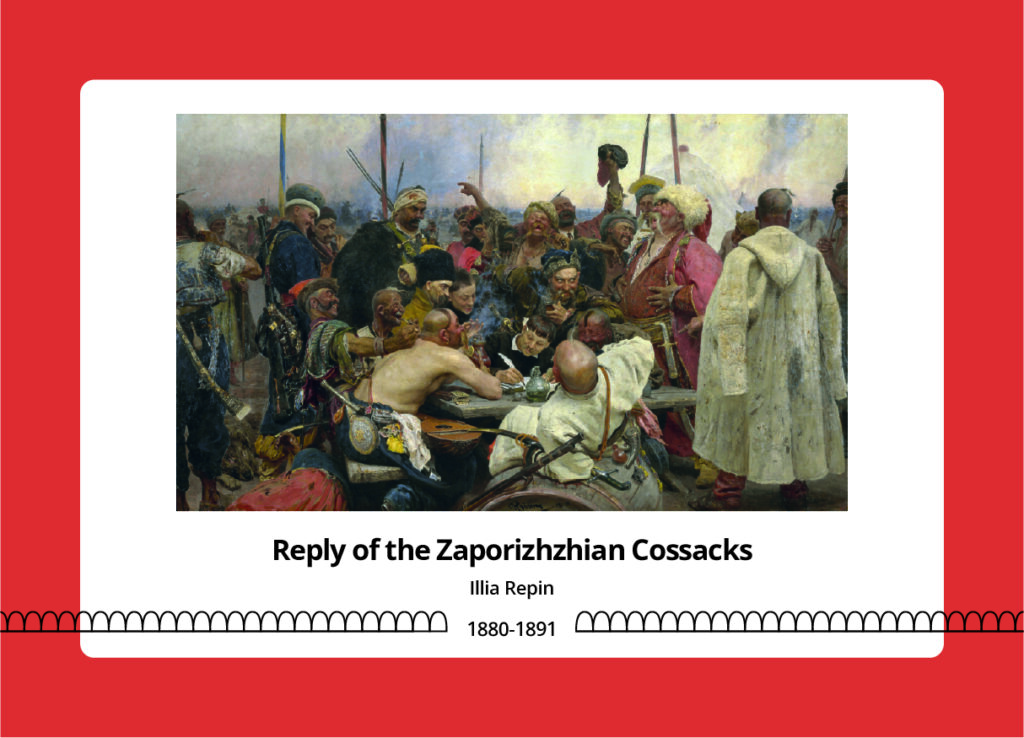
Reply of the Zaporozhian Cossacks, Illya Repin, 1880-1891
Kharkiv Art Museum
Master of realist art, Ilya Repin (1844-1930) was born into a Cossack family in Chuhuiv, Kharkiv oblast, Ukraine. For his most famous painting, “Cossacks Writing a Letter to the Turkish Sultan”, in 1880, he went on a journey through Ukraine for almost half a year to places of former Cossack glory – mostly Kharkiv, Chernihiv, Poltava, Dnipro and Zaporizhzha regions. According to legend, the letter was written in 1676 by the Kosh Ataman Ivan Sirko “with all the Kosh Zaporizhzhia” in response to an ultimatum from the Ottoman Sultan Mekhmed (Muhammad) IV. While travelling through Ukraine, he sketched houses, clothing, weapons, folk art, and architecture. Cossacks painted in this realism masterpiece were also real Ukrainian historical figures at that time – historians, writers, governors. Many naive artists recreated this picture, making it part of folk art.
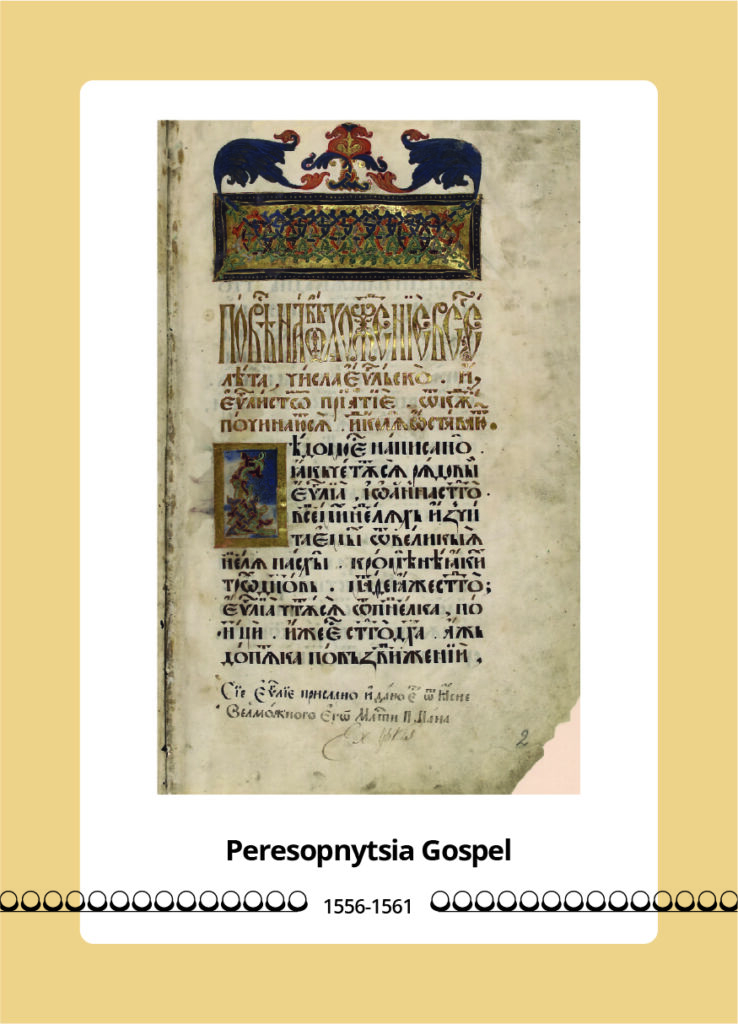
Peresopnytsia Gospel, 1556-1561
Vernadsky National Library of Ukraine
Peresopnytsia Gospel is one of the symbols of independence. Made in the 16th century, it is one of the first manuscripts written in Ruthenian (Old Ukrainian). The Peresopnytsia Gospel contains the four Gospels of the New Testament. It is ornamented with Cyrillic characters influenced by the Italian Renaissance style, with the icons in the Byzantine style, which is common for Ukrainian iconography. It was made between 1556 and 1561 at the Bernardine Monastery in Iziaslav, in the Grand Duchy of Lithuania, and at the Monastery of the Mother of God in Peresopnytsia (now in Ukraine). Since 1991, all Ukrainian presidents have taken the oath of office on this Gospel.
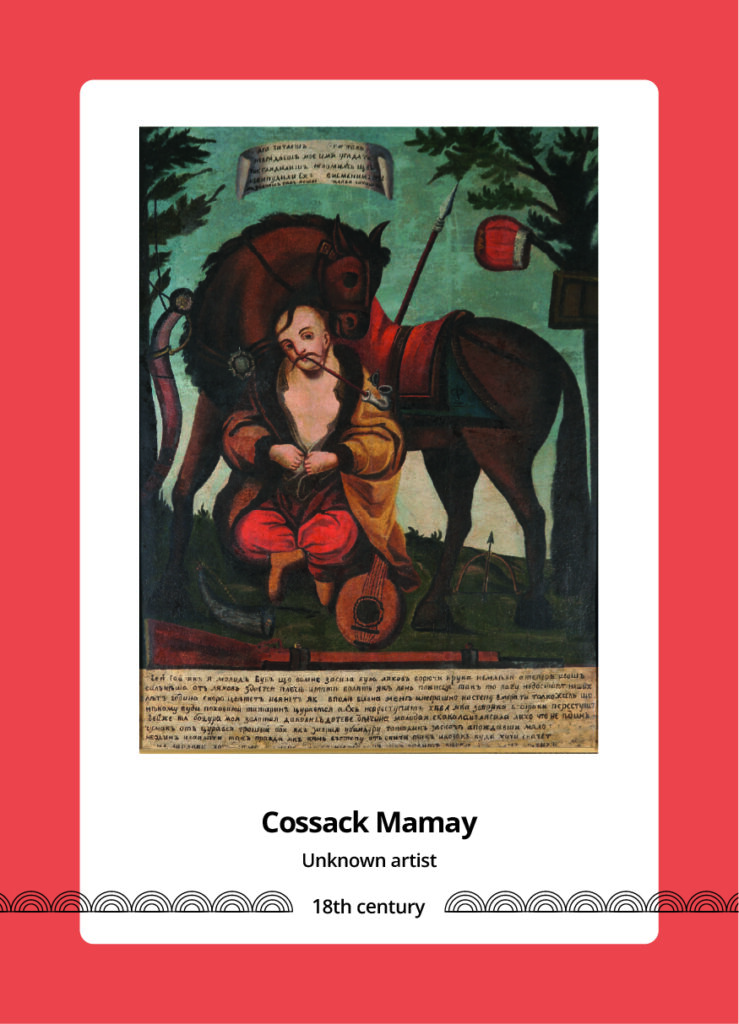
Cossack Mamay, Unknown artist, 18th century
Odesa National Fine Arts Museum
Cossack Mamay is one of the most common characters in Ukrainian folk paintings from the late 17th century to the present time. The image of a melancholic Cossack usually includes a kobza – a lute-like musical instrument; a horse, which represented freedom; and an oak with his weapons hanging on it. Often, the images include a list with a flag, a Cossack cap, and a glass. These were things related to the life and death of a Cossack—a spear was placed at the burial site, and a stem and a glass were placed in the grave. Paintings of Cossack Mamay could be seen around Ukraine in peasant and noble houses. Mamay is a symbol of freedom and strength, as Cossacks played a major role in defending Ukrainian lands and creating their own statehood.
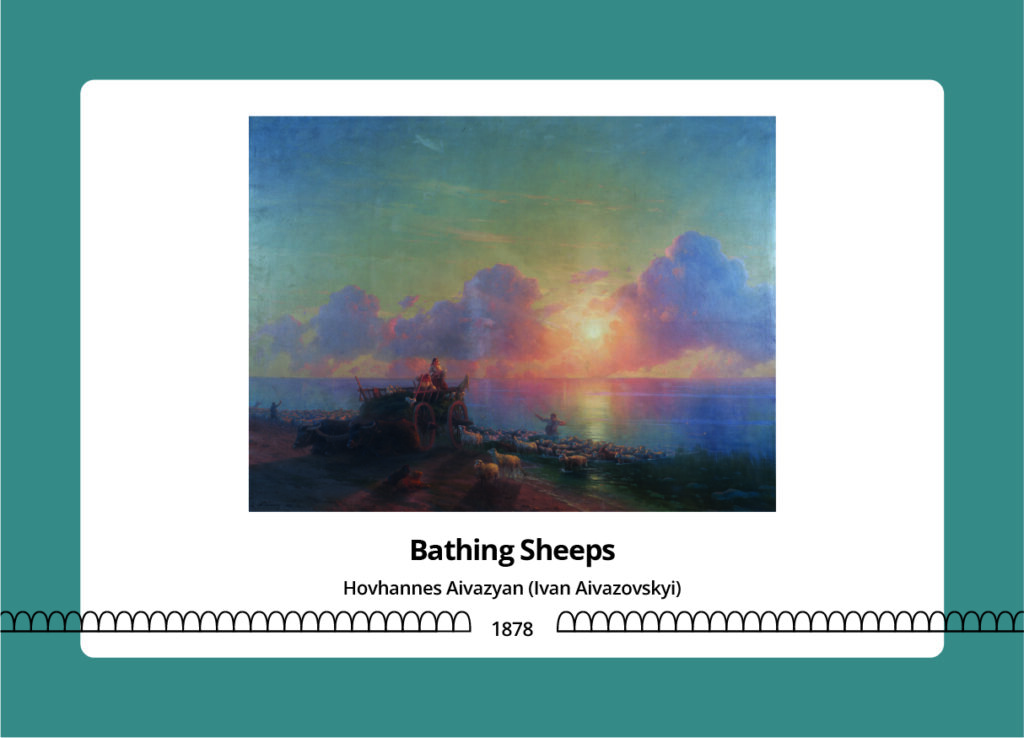
Bathing Sheeps, Hovhannes Aivazyan (Ivan Aivazovskyi), 1878
Odesa National Fine Arts Museum
Hovhannes Aivazyan (1817-1900) was born in Feodosia, Crimea, where his Armenian family emigrated from Galicia. To gain deserved recognition in the Russian Empire, Hovhannes was forced to Russify his name and became Ivan Aivazovsky, as he is known throughout the world. The name Feodosia also came from the Russian Empire – the original Crimean Tatar name of the city is Kefe. The renowned marine painter lived in Feodosia for almost his entire life. In his paintings, Aivazian depicted a diverse, multicultural Crimea, including Crimean Tatars, Ukrainians, and Armenians. “Bathing of Sheep” is one of the highlights of the collection of the Odesa Art Museum. Aivazyan bequeathed most of his works to Feodosia. He also forbade taking these works away from Crimea. Since 2014, after the annexation of Crimea, the occupation authorities have repeatedly violated the artist’s will.
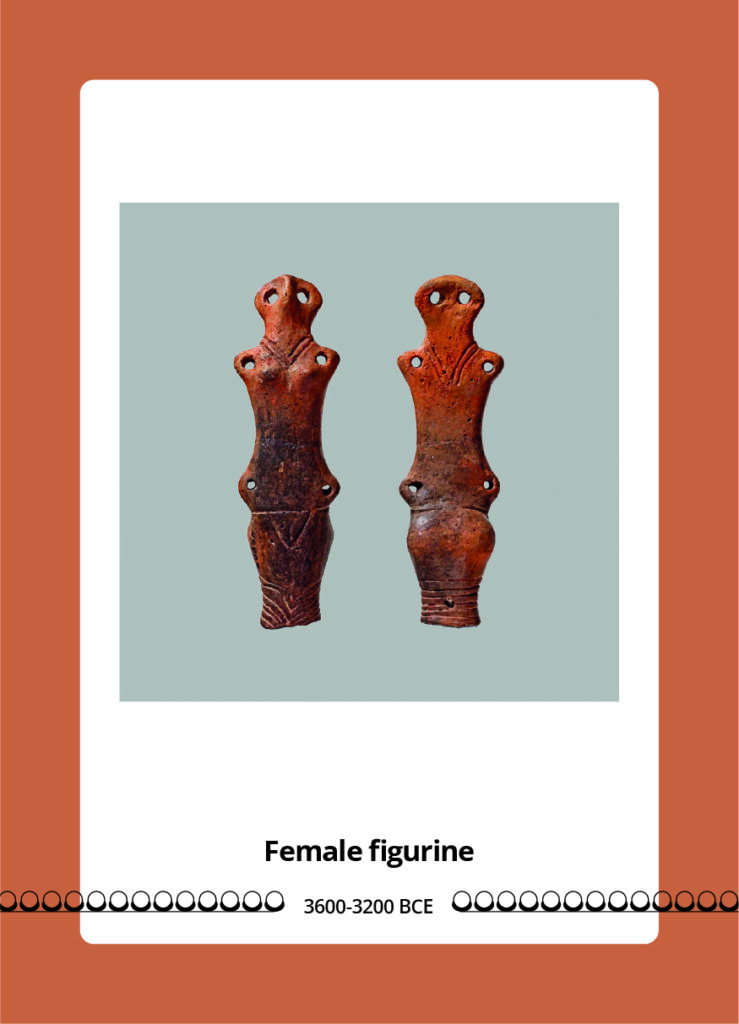
Female figurine, 3600-3200 BC
National Museum of the History of Ukraine
The Trypillian culture, or the Cucuteni-Trypillian culture, is one of the most mysterious archaeological cultures in Europe. It existed on the territory of modern Ukraine, Moldova, and Romania during the 6th–3rd millennium BC. The Ukrainian name comes from the name of the village of Trypillia in the Kyiv region. The area of distribution of the Trypillia people is in present-day Ukrainian lands, from the Carpathians to the Dnipro, from Polissya to the Black Sea. They created complex ceramics with geometric and spiral patterns, using red, black, and white colours. They cultivated the land, kept livestock, made looms, spinning wheels, flint sickles, and copper tools. They also created clay figurines of women, animals, and models of dwellings — probably for ritual purposes. In Ukraine, Vikentij Khvojka discovered the first monuments of this culture at the end of the 19th century.
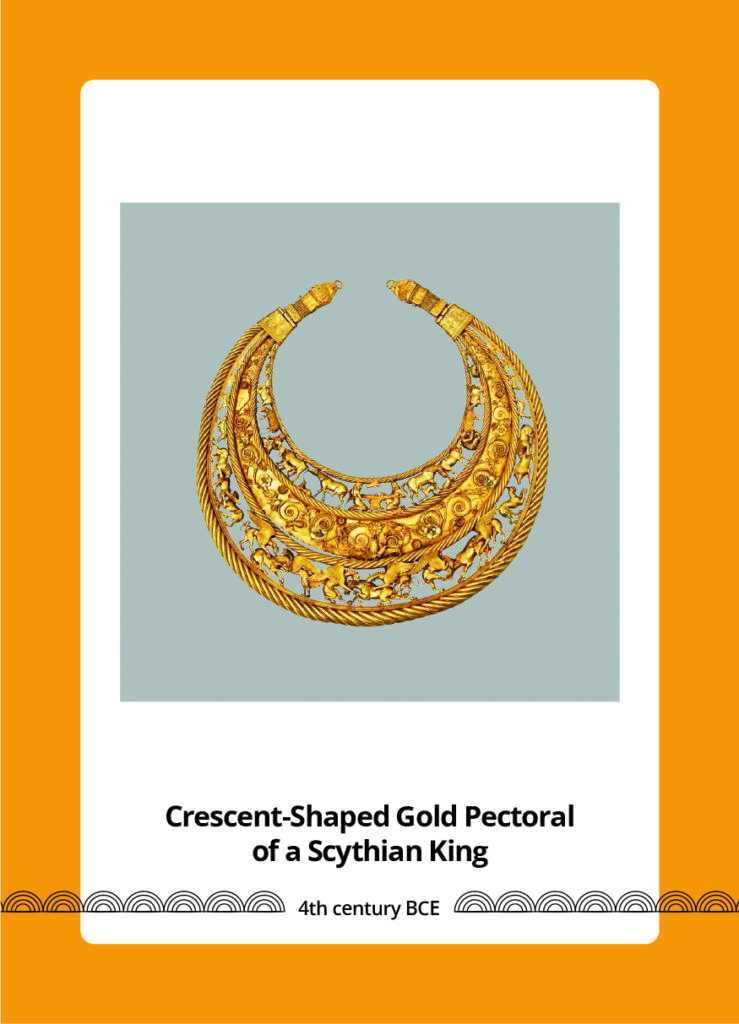
Crescent-Shaped Gold Pectoral of a Scythian King, 4. century BC
National Museum of the History of Ukraine
Scythians were nomadic people who migrated from Central Asia to the Pontic Steppe in modern-day Ukraine during the 9th to 8th centuries BC, where they remained until the 3rd century BC. Herodotus called contemporary Ukrainian lands from the Danube to the Don rivers Great Scythia.A gold pectoral (collar or breastplate) was discovered in a burial kurgan at a site called Tovsta Mohyla in the modern Dnipro region, Ukraine, in 1971. It was made either by the native Scythian artisans or by ancient Greek craftsmen on order of the Scythian nobility in the second quarter of the 4th century BC in the jewellery workshops of Athens or Panticapaeum. The top section reflects Scythian daily life. The middle section is believed to represent Scythian connection to nature. The third section is thought to represent Scythian belief in the cosmos and their mythology.
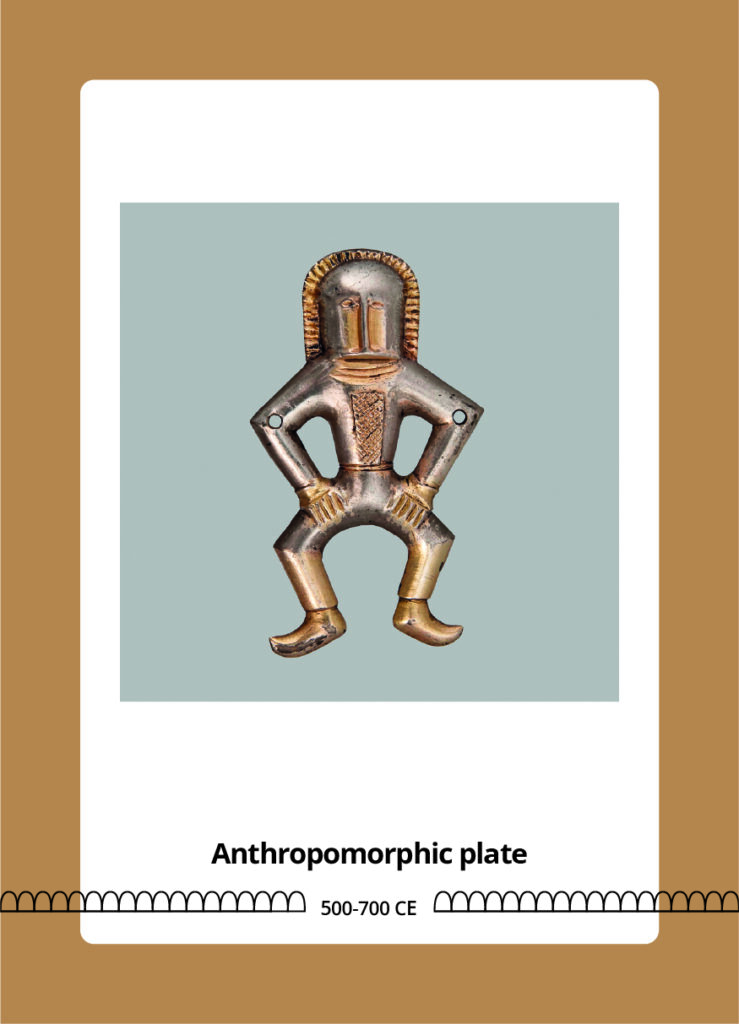
Anthropomorphic plate, 500-700 CE
National Museum of the History of Ukraine
The anthropomorphic plate with a person wearing an embroidered shirt was found as part of the Martynivka treasure in 1907 on the banks of the Ros River, in the village of Martynivka, Cherkasy region. It consists of 116 silver items and dates back to the 6th–7th centuries. The treasure’s contents are considered artefacts of the Penkiv culture, associated with the early Slavic tribe of the Ants. The Penkiv culture existed from the 5th to the 8th centuries, from the river Prut to the Siversky Donets, occupying mainly the forest-steppe part of Ukraine. The carriers of the Penkiv culture were the Ants, one of the most famous Slavic groups of the early Middle Ages. Like representatives of other cultures, they settled along rivers.
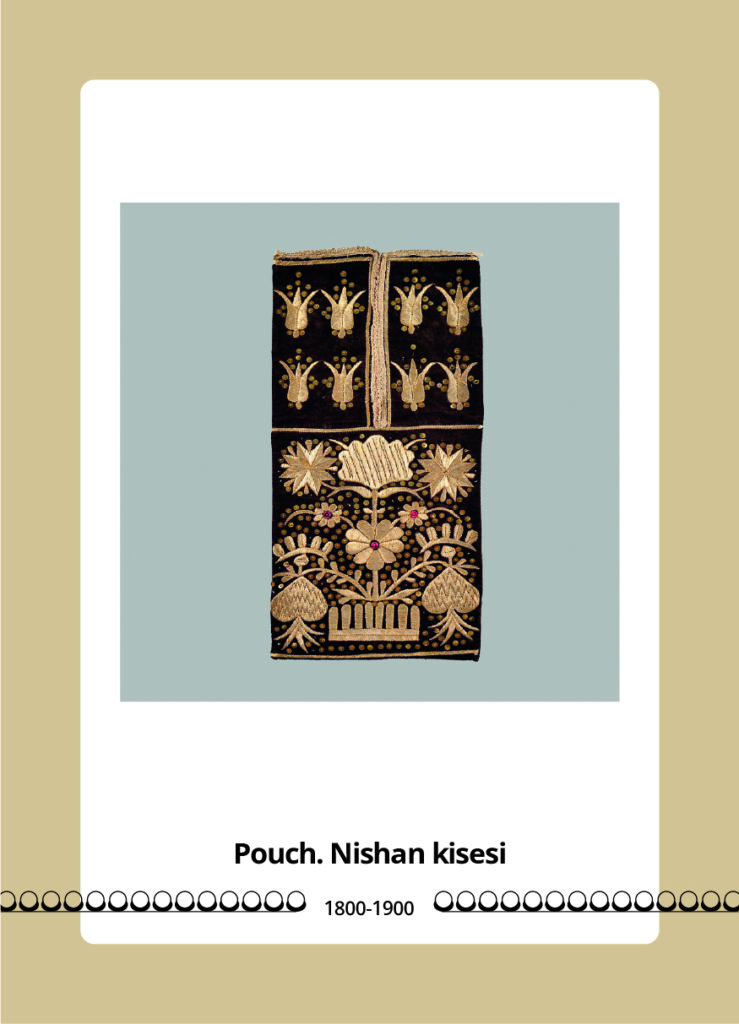
Pouch. Nishan kisesi,1800-1900
National Museum of the History of Ukraine
This special pouch was part of the “dok’uz” ceremony, during which the bride presented her future husband with a set of nine items embroidered with ornek. Örnek is a traditional Crimean Tatar ornament that was used almost everywhere – on clothes, shoes, jewellery, ceramic and metal dishes, wooden products, furniture decoration, and carpets. After the deportation of Crimean Tatars in 1944 under Soviet rule, depriving the entire nation of its ethnocultural environment, the ornament almost disappeared from Crimea. It returned in 1991, when Crimean Tatars could finally return to their native land. Now many contemporary artists continue to develop their traditional ornament. In 2021, Örnek and its knowledge were inscribed on the UNESCO Intangible Cultural Heritage List.
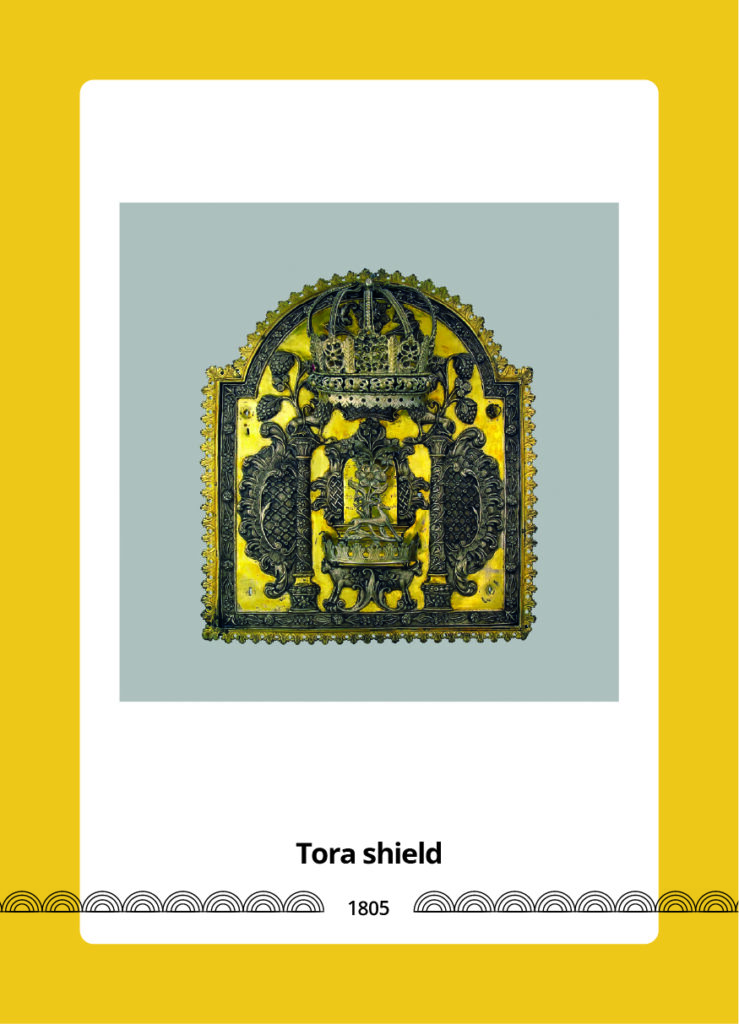
Torah Shield, 1805
National Museum of the History of Ukraine
Jews have always been one of the largest national minorities in Ukraine and were a major part of cultural and social life. The Torah shield from Lokhvytsia, Poltava region, belongs to the traditional circle of objects that accompany the synagogue event associated with the main shrine for Jews – the Torah. It hung from a chain attached to the scroll and was used in synagogues and prayer houses during the ceremony of carrying and reading the Torah. The decorative design of the shield from Lokhvytsia is distinguished by high craftsmanship and a richness of symbolic images.
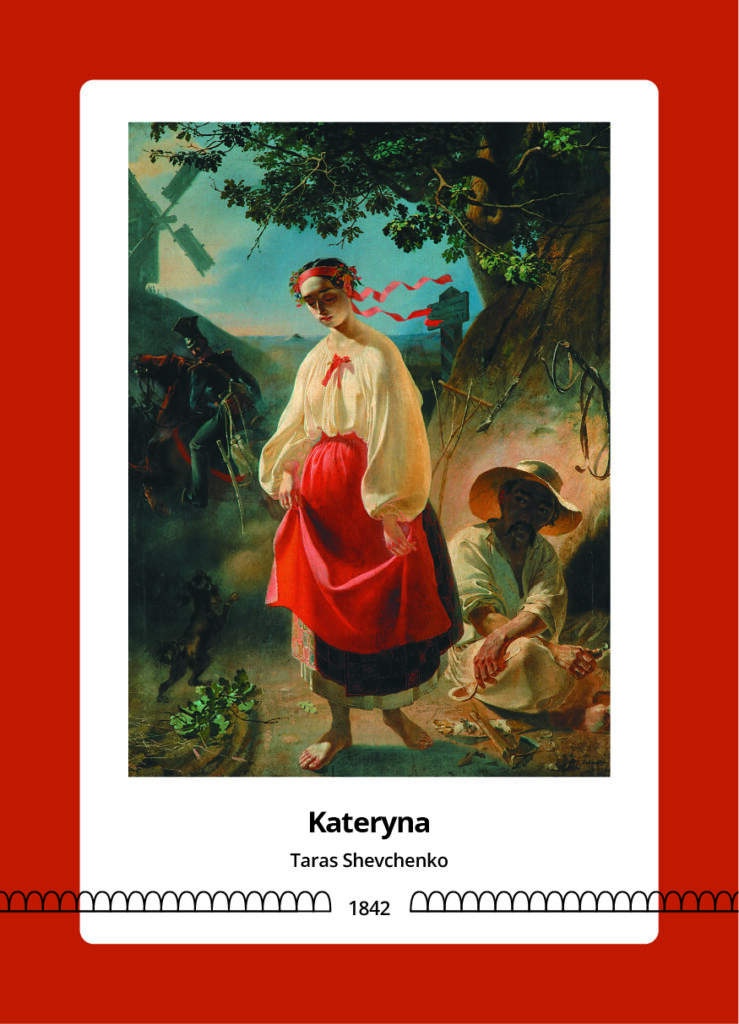
Kateryna, Taras Shevchenko, 1842
Taras Shevchenko National Museum
Taras Shevchenko (1814-1861) is known for both his painting and poetry, and “Kateryna” is where a poem and a painting met in the artist’s work. A village girl falls in love and gives herself to a “Muscovite” — a soldier of the Russian imperial army who was sent for temporary service in Ukraine. She becomes pregnant; he leaves her. Kateryna has a newborn son and faces the condemnation of her fellow villagers and even her parents. The poem ends with Katerina drowning in a lake, and her son being raised by a blind kobzar. The poem was written during the time when to write, publish or use in public Ukrainian language was forbidden due to Russian imperial law. Kateryna symbolises Ukraine, which was colonized by Russia and Ukrainians were turned into serfs (kripaky). Shevchenko was born as serf and got his freedom only in 1838. Soon he was arrested for writing in Ukrainian language and sent to exile “under the strictest surveillance, without the right to write or paint”. But he did it secretly. Now Shevchenko is a symbol of Ukrainian struggle for independence and probably the best known Ukrainian poet.
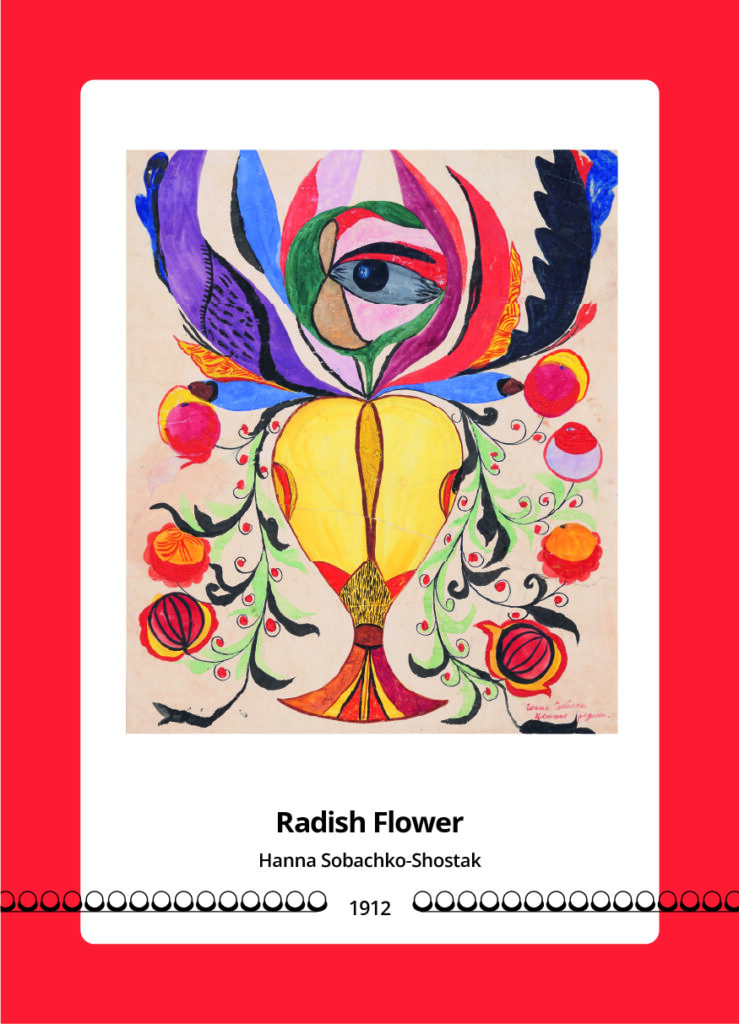
Radish Flower, Hanna Sobachko-Shostak, 1912
National Decorative Arts Museum of Ukraine
Hanna Sobachko-Shostak (1883-1965) was a self-taught artist who was part of Verbivka workshops that connected peasant artists and such avantgardists as Alexandra Exter and Kazimir Malevich. The avant-garde artists created sketches for embroidery, and the peasant women embroidered them. Hanna was noticed for her artistic mix of Ukrainian tradition and modernism. Sobachko-Shostak created flowers that did not exist in nature. As a true modernist, she believed that there was no point in copying reality. Each flower created by Hanna was not repeated in color or shape. Her art mixes Her art was seen in major cities around the world in the 1910-20s – Kyiv, Berlin, Paris, and after 2022 – New York, London, Vienna, Warsaw.
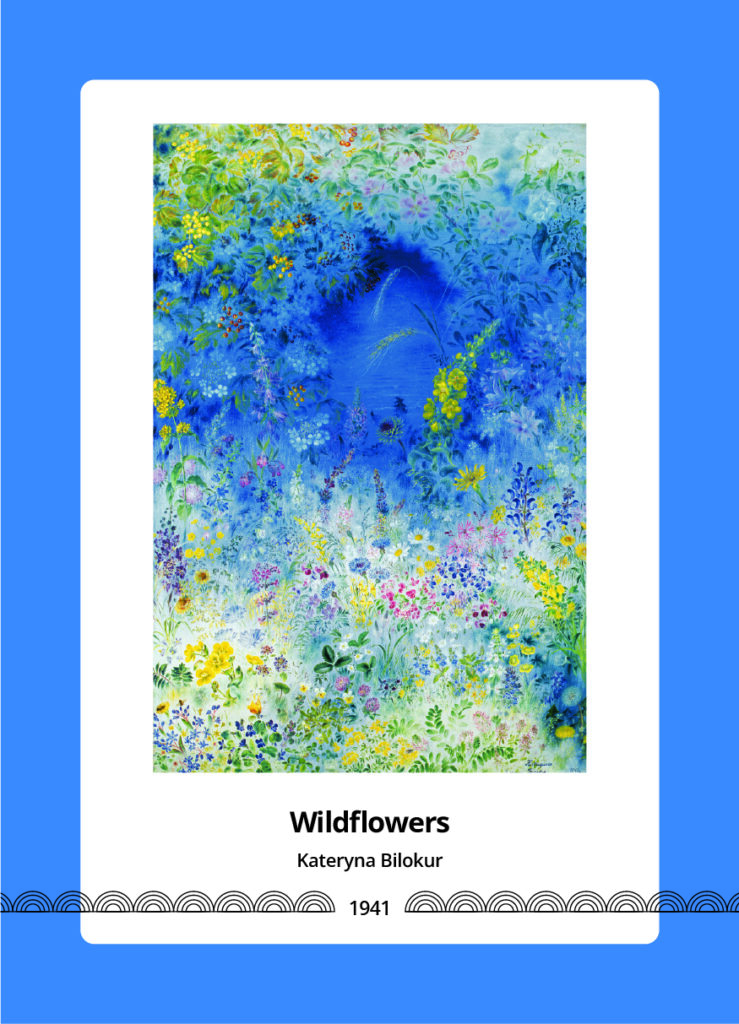
Wildflowers, Kateryna Bilokur, 1941
National Decorative Arts Museum of Ukraine
A self-taught artist from the village of Bohdanivka, Kyiv region, Kateryna Bilokur (1900-1961) became famous for her painted flowers. Blue was special to Bilokur. Her strongest artistic impression in childhood was a blue flower she saw in a field. This blue colour captivated her and was her favourite for a long time. She learned how to paint using white sheets and a piece of coal. Later she painted with homemade paints – from viburnum, elderberry, and onion. In 1940, the works were shown for the first time in the Poltava Museum. Kateryna began receiving artificial paints as gifts, and her favourite colours became ultramarine and cobalt blue. She painted in these tones during World War II and the nazi occupation of her native village in the Kyiv region. In 1957, Bilokur’s artworks were shown in Paris, while she lived poorly and didn’t have a passport, like any other Ukrainian peasant forced to work on the Soviet collective farm for almost no pay.
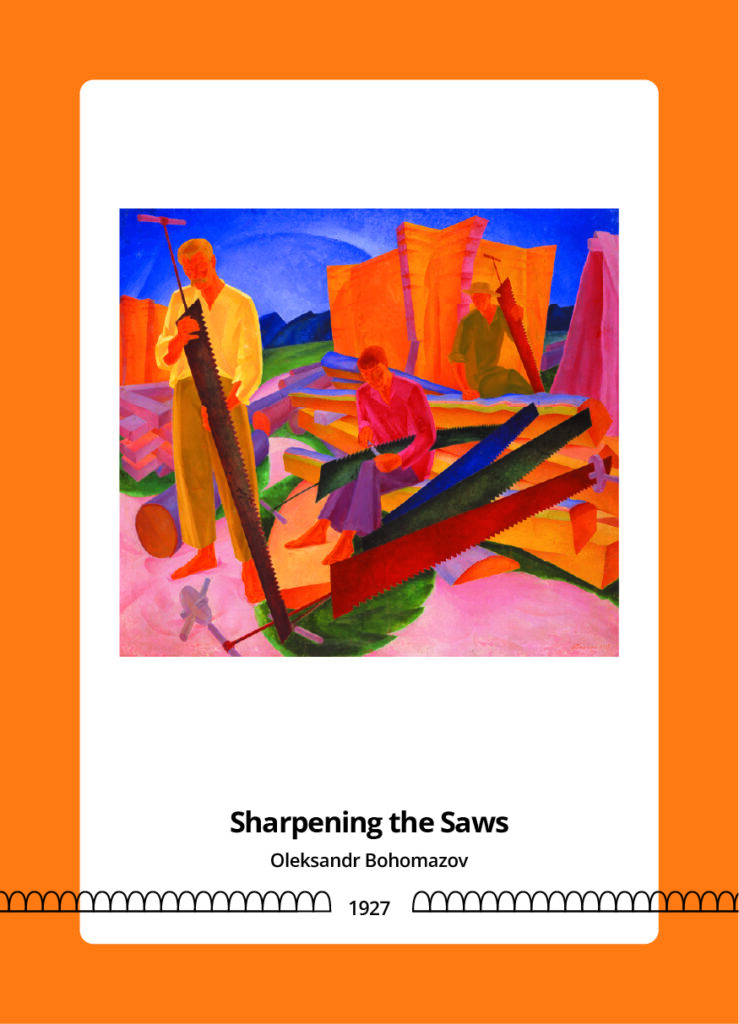
Sharpening the Saws, Oleksandr Bohomazov, 1927
National Art Museum of Ukraine
One of the most prominent theorists of the Ukrainian avant-garde, Oleksandr Bohomazov (1880-1930), wrote his treatise “Painting and Elements” in 1914. He expounds on the essence of the four elements: line, form, plane, and colour. This is how the idea of Cubo-Futurism was formed—geometry in dynamics. Bohomazov’s entire life was connected with Kyiv, unlike other avant-garde artists who also studied in Europe. Nevertheless, two trips to Finland (1914) and Armenia (1915-1916) influenced his artistic pursuits. In 1927, the artist began working on perhaps his most famous work—the triptych “The Work of the Sawmillers.” He put all the vital forces that had already left his body because of tuberculosis into this work. In 1930, the work was selected for the Soviet pavilion at the Venice Biennale. He did not wait for enthusiastic reviews—he died before the Biennale opened. “Sharpening the Saws” ended up in the special collection of the Kyiv State Museum of Ukrainian Art (now NAMU) and was supposed to be destroyed. But, fortunately, they have survived to this day and have been exhibited all over the world.
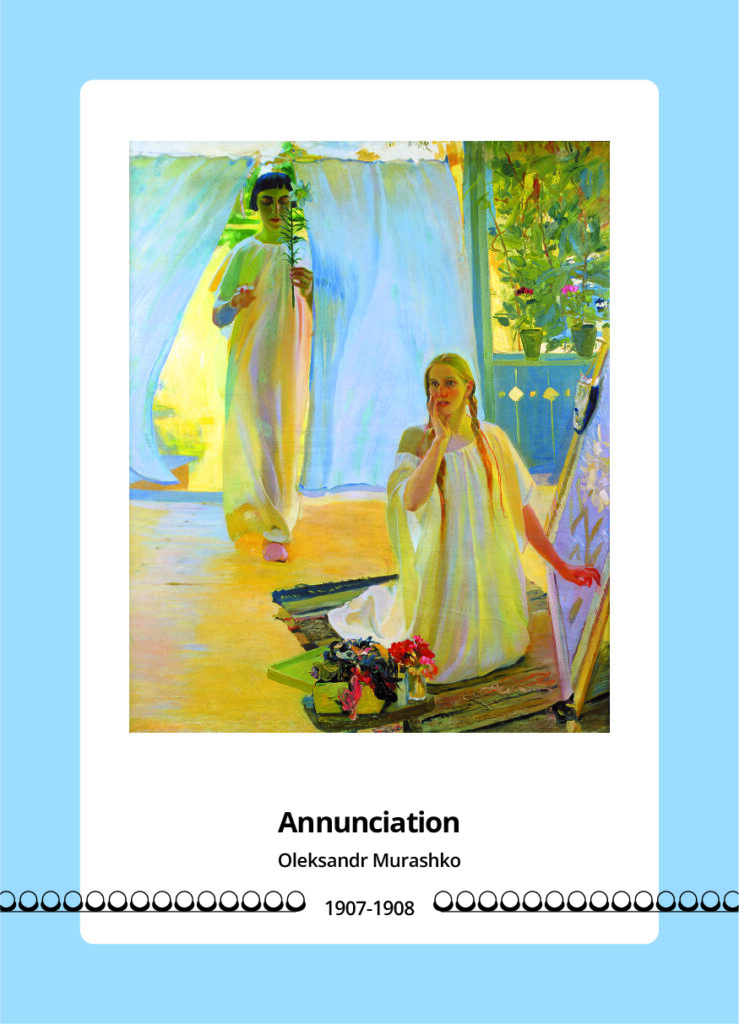
Annuancion, Oleksandr Murashko, 1907-1908
National Art Museum of Ukraine
Oleksandr Murashko was one of the most successful Ukrainian artists of his time. Studied with Ilya Repin as a realist painter; the trip to Paris changed his art forever. Murashko’s impressionistic paintings were shown in Berlin, Vienna, Paris, Venice, and Budapest, and were regularly published in art magazines. One of Murashko’s masterpieces is The Annunciation. Created in a modern style, it hardly resembles a classical religious plot. Only details tell us what is happening – a lily in the hands of the archangel and a red thread on the shoulder of the Virgin Mary. Murashko’s happy life was interrupted by a murder under mysterious circumstances. It seems like the murder was for political reasons, because it was at this time that the Bolsheviks carried out the so-called “purges” of the Ukrainian artists and writers.
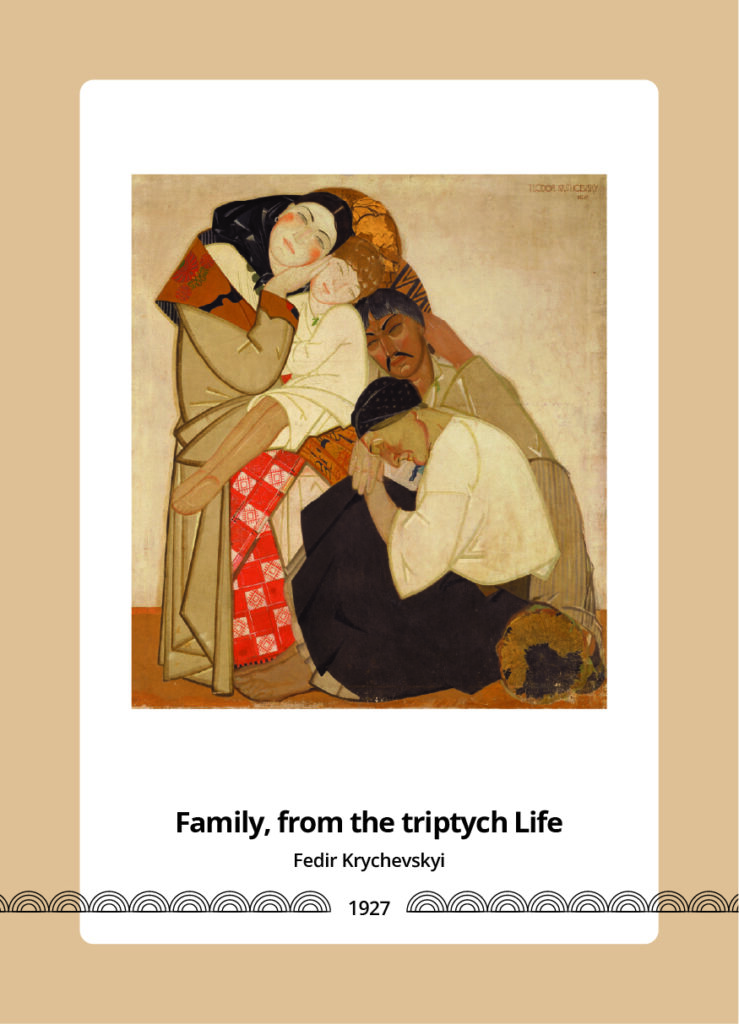
Family, from triptych Life, Fedir Krychevsky, 1927
National Art Museum of Ukraine
Ukrainian modernist Fedir Krychevsky created the triptych “Life” in 1927 — after World War I, after short years of Ukrainian independence and the Bolshevik occupation. The first part of the triptych, “The Kiss”, shows a woman standing on her knees with her hands raised and seems to be completely surrendering to the power of love and passion. The central part — “Family” — unites three generations. The lovers have already had a son. They hug him as if protecting him from the outside world with their paternal love. Nearby, we see an older woman, a grandmother: Krychevsky emphasises that for Ukrainians, a family is several generations and relatives, not just parents and children. The triptych is completed by the tragic part of “The Return”: the son returns home from the war to his elderly parents, having lost his leg. Parental love was not enough to protect him from the world’s cruelty. The “Life” was shown at the Venice Biennale in 1927 and was highly appreciated.
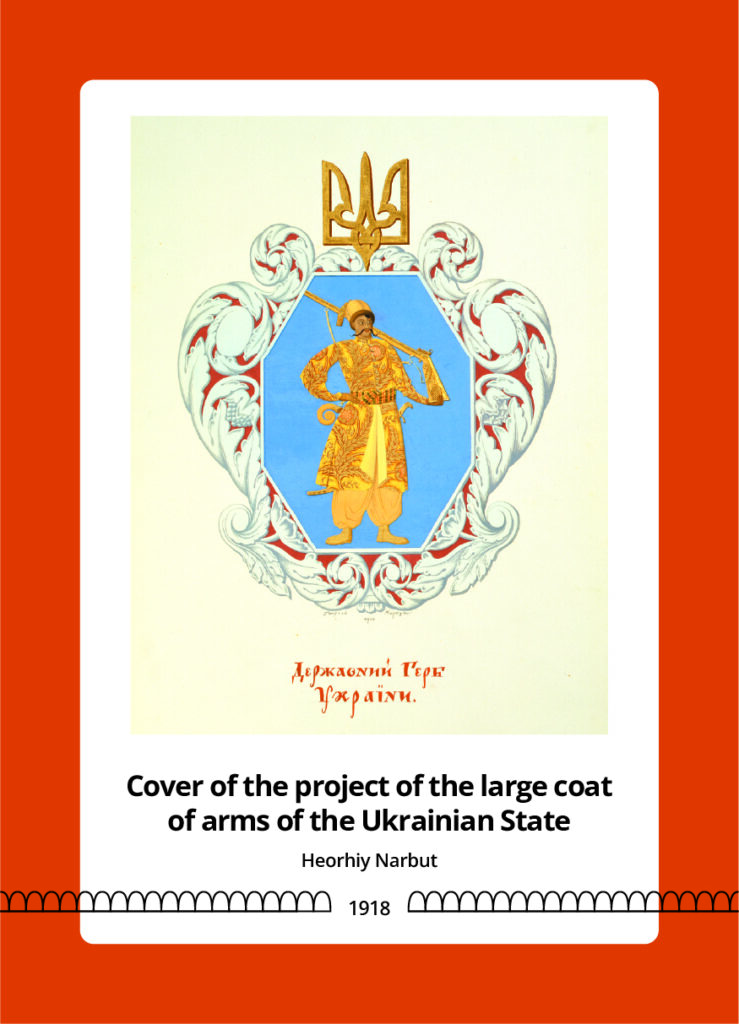
Cover of the project of the large coat of arms of the Ukrainian State, Heorhiy Narbut, 1918
National Art Museum of Ukraine
Heorhii Narbut (1886 – 1920) is often called the designer of the Ukrainian state. He designed the coat of arms, seals, stamps and money of the Ukrainian People’s Republic, established in 1917. For a short period of independence, during constant attacks from Russian forces, both imperial and Bolshevik, Ukraine did a lot to build its institutions and statehood. In 1918, the Ukrainian Academy of Arts was established, where Narbut was the first rector. He designed 13 of the 24 banknotes issued by the Ukrainian state during 1917–1920. The inscriptions on the banknotes were not only in Ukrainian, but also in the languages of the most numerous national minorities – Polish and Yiddish. The symbols of the Ukrainian People’s Republic were based on the symbols of the Zaporizhzhian Army and Cossack Baroque. In 1921, Bolshevik forces occupied Ukraine, and it became the Ukrainian Soviet Socialist Republic.
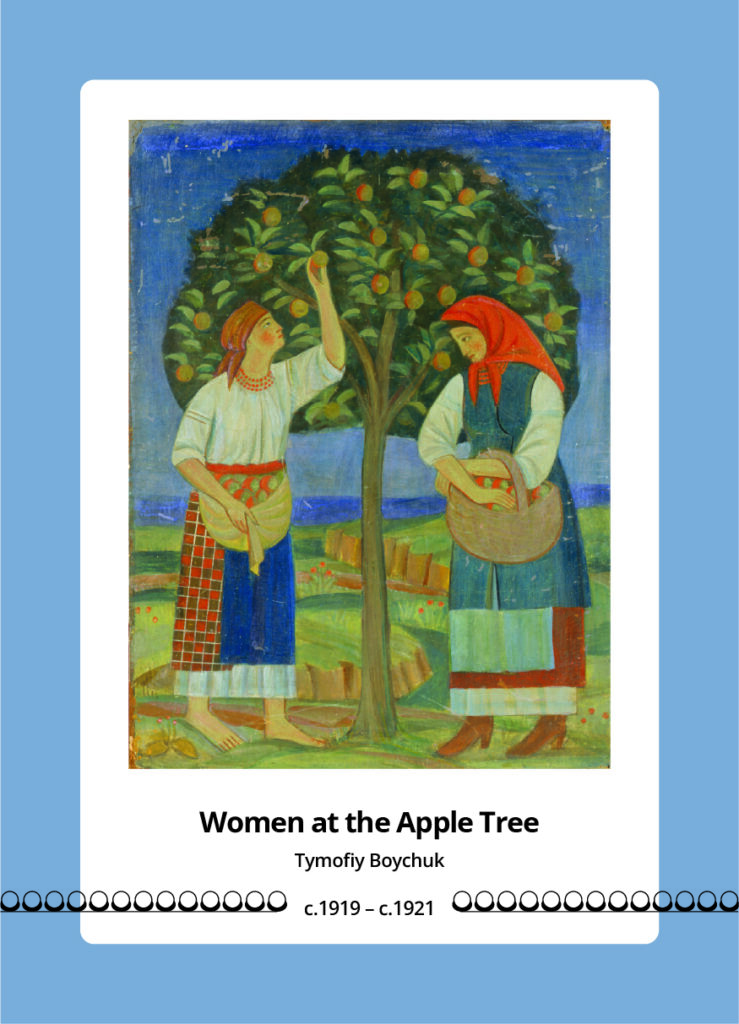
Women at the Apple Tree, Tymofiy Boychuk, c.1919 – c.1921
National Art Museum of Ukraine
In 1909, Mykhailo Boichuk (1882-1937) founded his own studio school in Paris to revive Byzantine art. Later, he came back to Ukraine and aimed to create a new Ukrainian style based on Byzantine art, the Renaissance, folk art, and modernism. The group of Ukrainian, Polish, and Jewish artists who studied and worked with him were known as the Boychukists. His younger brother Tymofiy (1896-1922) was among them. The apple tree was a popular symbol among the Boychukists, meaning life and harmony, and was also based on the writings of Ukrainian philosopher Hryhoriy Skovoroda. Boychukists worked with paintings, graphics, frescoes, mosaics and decorative art. In 1937, Boychukists were repressed and killed by the soviet authoritites for their “bourgeois nationalist” art, which actually meant a strong Ukrainian identity. After 1937, their works were destroyed and burned, and few of them remain in art museum collections.
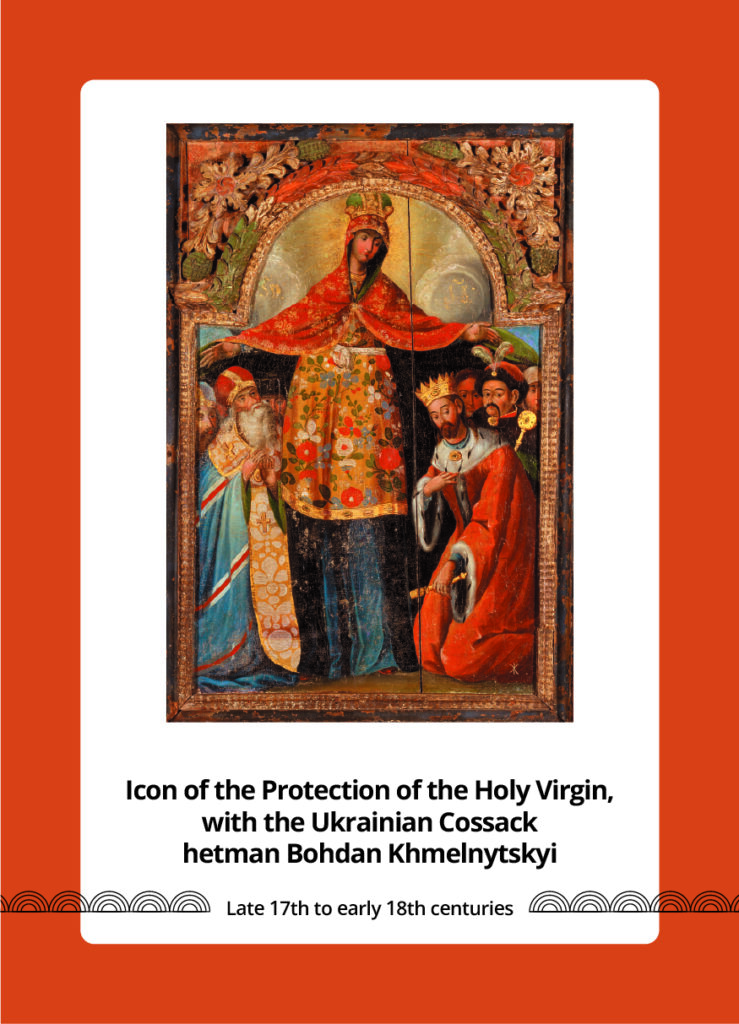
Icon of the Protection of the Holy Virgin, with the Ukrainian Cossack hetman Bohdan Khmelnytsky. Late 17 to early 18th C
National Art Museum of Ukraine
In the mid-17th century, a Cossack state emerged on the territory of Ukraine, led by Hetman Bohdan Khmelnytsky. The Zaporizhzhian Cossacks had a special cult of the Virgin Mary as an intercessor and protector from the enemy. On such icons of the Cossack Baroque, real historical figures or noble families were often depicted among the praying people, to honour their memory or as gratitude for patronage.
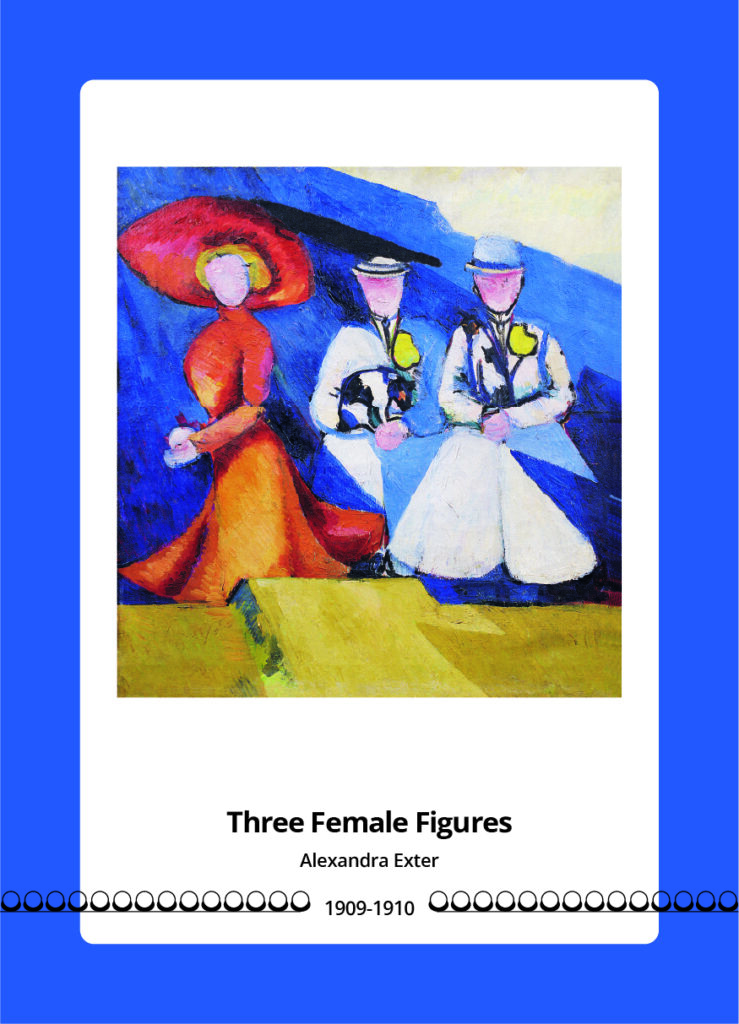
Alexandra Exter, Three Female Figures, 1909-1910
National Art Museum of Ukraine
Alexandra Exter (1882-1949) is one of the first female avant-garde artists whose works can now be seen around the world in the best modern art collections. Born in Bialystok, Poland, Exter shaped her style in Kyiv, where she lived from age three. In the beginning of the 20th century, Kyiv was a centre of avangardian art. In 1908, with David Burliuk, Exter curated the first exhibition in the Russian Empire of avant-garde art. That same year, she took part in the first major exhibition of Ukrainian traditional art in what is now the National Art Museum of Ukraine. Studying among Georges Braque and Pablo Picasso in Paris, she returned to Kyiv in 1914 to work together with artists from the Ukrainian village and avant-gardists such as Kazimir Malevich, creating avangardian embroidery, later known as Verbivka workshops. Alexandra Exter became a central figure of theatre life, bringing her vibrant colours to decorations and costumes. After the establishment of Soviet rule, many artists immigrated to escape repression. In 1924, Exter moved to France, where she spent the rest of her life as a theatre designer, teacher and illustrator.
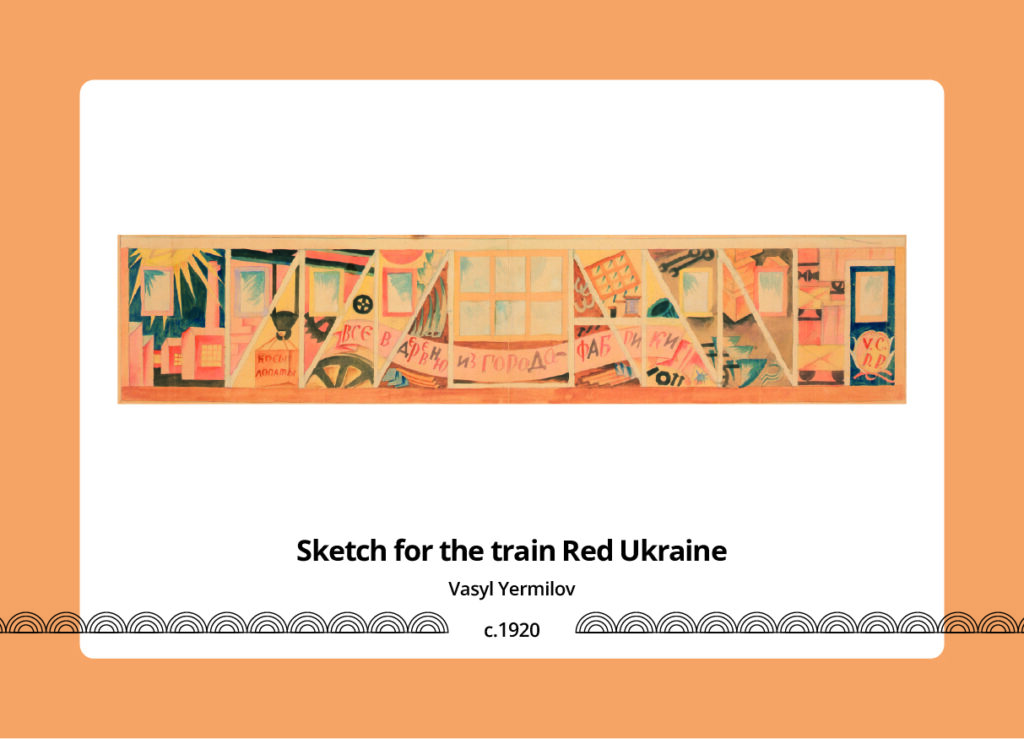
Sketch for the train “Red Ukraine”, Vasyl Yermilov, c.1920
National Art Museum of Ukraine
Kharkiv was one of the capitals of the Ukrainian avant-garde. Many world-famous artists were born or worked there – Maria Siniakova, David Burliuk, El Lissitzky, Volodymyr Tatlin and many others. Vasyl Yermilov perceived artists as “makers” and called himself a constructivist. He believed that art should be present in everyday life – from posters on the street to furniture in the house. Yermilov was the founder of Ukrainian industrial design – he developed and created sketches for packaging and matchbox designs, developed fonts, and also created covers. Once he even painted an entire train – the carriages resembled Ukrainian chests decorated with decorative painting. The train was dedicated to the Soviet government in Ukraine. Yermilov, like many avant-garde artists, at first perceived the Bolshevik government positively. However, very soon, many of these artists were repressed.
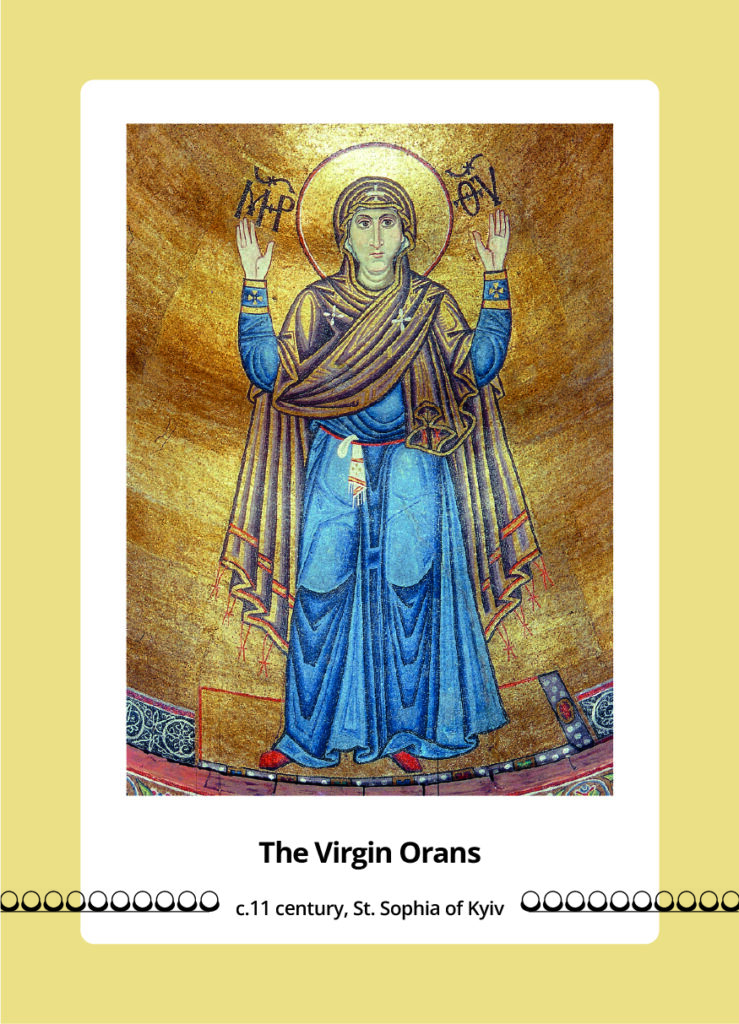
The Virgin Orans, Unknown, c. 11th century,
St. Sophia Cathedral of Kyiv
St. Sophia Cathedral in Kyivan is one of the oldest churches in Ukraine, built in 1017—1037 by Yaroslav the Wise, son of Volodymyr the Great, who converted Kyiv Rus to Christianity. Mosaics, frescoes and the initial architecture were created in the Byzantine style. On the walls of St. Sophia Cathedral, inscriptions and drawings left by priests and visitors remain. These inscriptions and drawings contain valuable information about various aspects of the life of Kyivan Rus. One of the most famous frescoes is the Virgin Orans, which seems to give blessings and protect with her cover. After the Mongol invasion, the temple began to decline and was restored by Ivan Mazepa in the 17th century, so the cathedral’s contemporary facade is an example of Cossack Baroque. St. Sophia’s Cathedral is recognised as a UNESCO World Heritage site.
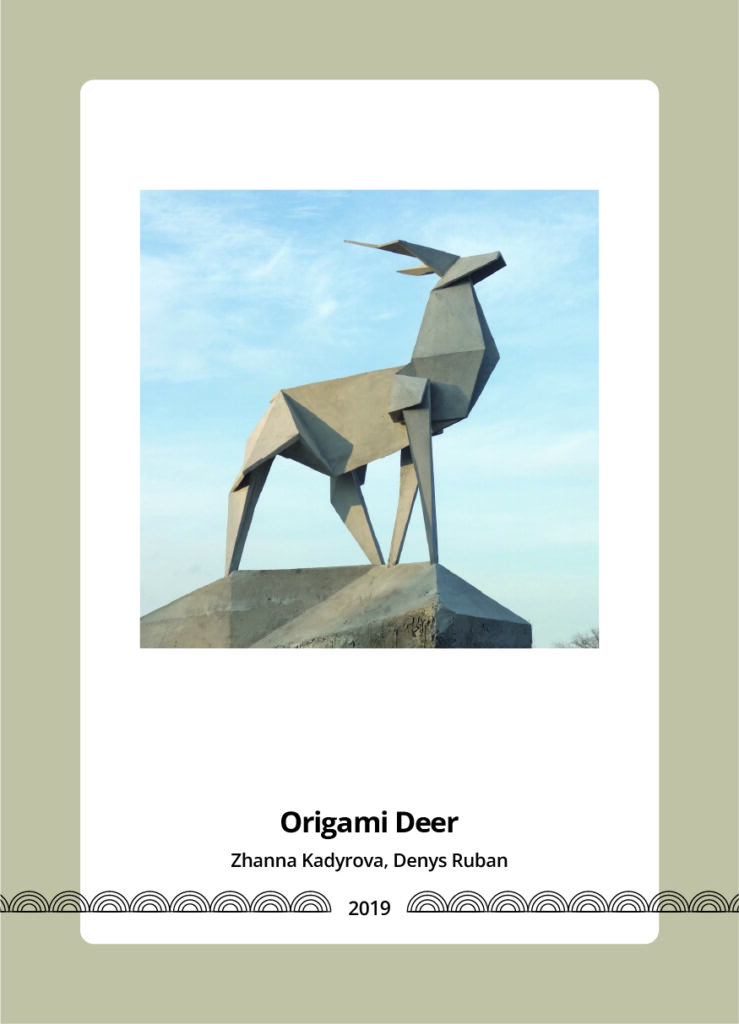
Origami Deer from the project Security Guarantees, Zhanna Kadyrova, Denys Ruban 2026
Origami Deer was installed in 2019 in Yuvileynyi (Jubilee) Park in Pokrovsk, Donetsk region — on the site of a dismantled Soviet nuclear-capable aircraft. In 1994, Ukraine gave up its nuclear weapons and destroyed aircraft for security guarantees from the U.S.A, the United Kingdom, France and Russia. After Russian full-scale invasion and as the front line approached Pokrovsk in 2024, the origami deer was evacuated. Now the city no longer exists and is entirely destroyed. The Origami deer travelled nearly 7000 kilometres through Warsaw, Berlin, Vienna, Brussels and Paris to represent Ukraine at the Venice Biennale. The sculpture is exhibited suspended from a truck crane, symbolising the uncertainty familiar to Ukrainians today and serving as a metaphor for forced displacement.
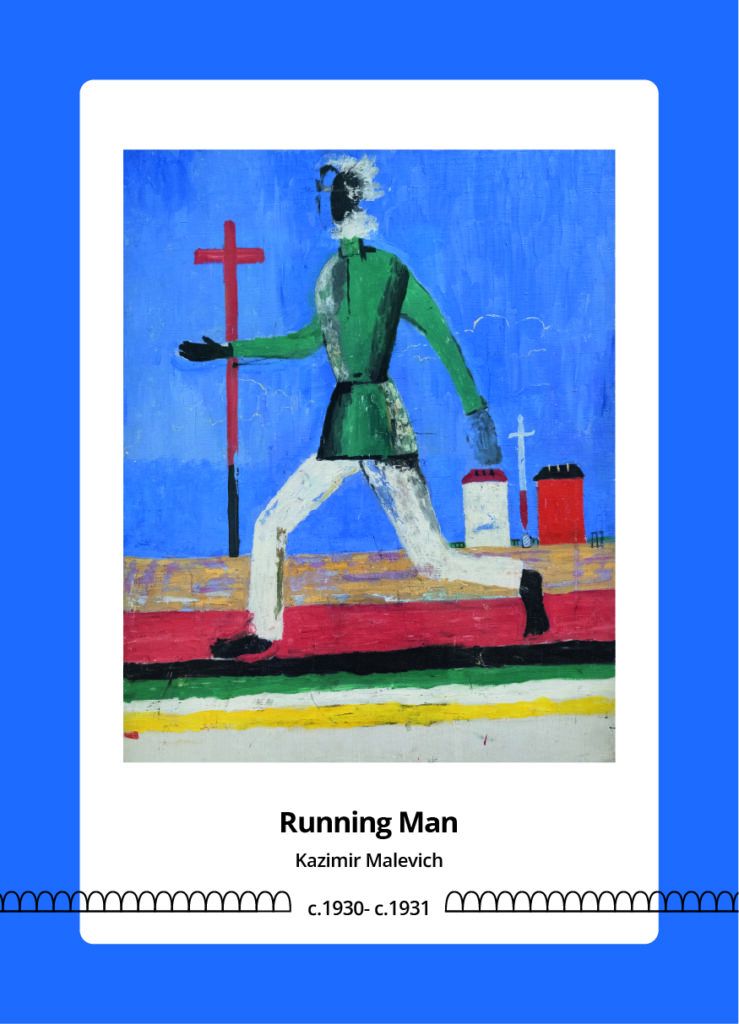
Kazimir Malevich, Running Man, c. 1930- c. 1931
Centre Pompidou
Throughout his life, Kazimir Malevich (1879-1935) emphasised that his artistic vision of the world was shaped by the Ukrainian village. Born in Kyiv into a Polish family, he spent his childhood in Ukrainian villages among traditional art. “The village was engaged in art, but I did not know this word then” he wrote in his memoirs. As a person closely connected to the village, Malevich was deeply affected by the Holodomor, an artificial famine in 1932-1933 made by Stalin to starve to death the Ukrainian village. Peasants didn’t want to go to collective farms – to work for free without choice. Their small soil could feed their families. Politics of collectivisation didn’t work, so Stalin decided to break peasants with famine – taking food and seeds. Around 4 million people died over two years. “Running Man” shows a peasant who tries to escape from the dying village. Malevich faced repressions himself. In the 1930s he returned from Kyiv, where he was professor at Kyiv Art Institute to Russia, and was accused of espionage and imprisoned for three months. To talk publicly about Holodomor was forbidden until Ukrainian independence in 1991.
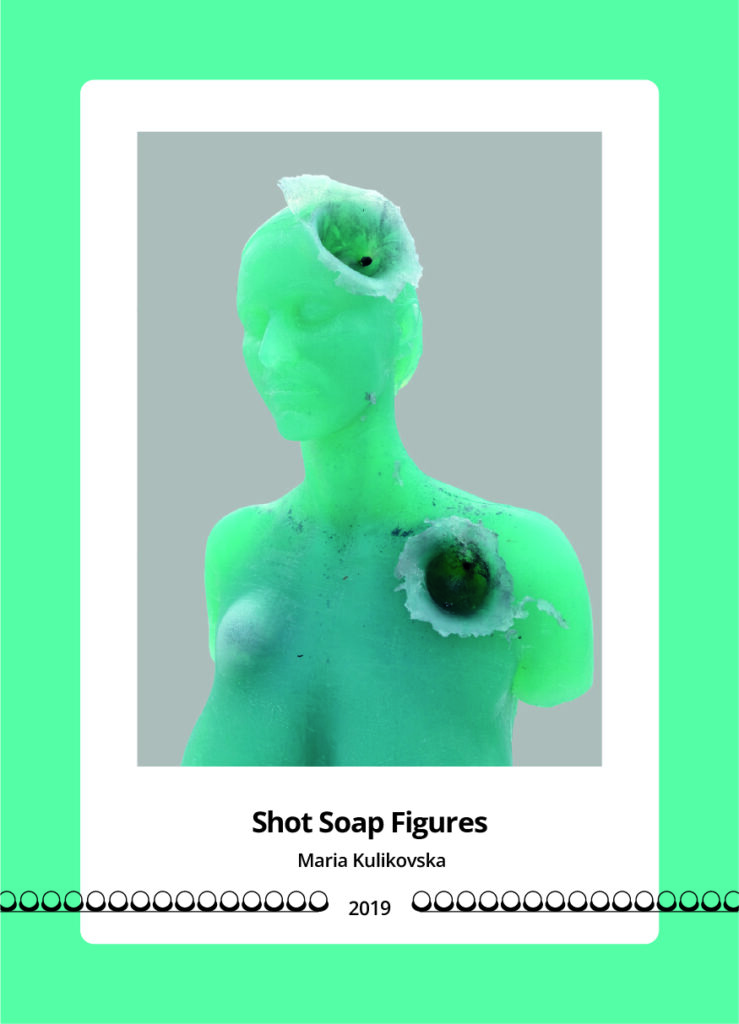
Shot Soap Figures, Maria Kulikovska, 2019
«Homo Bulla – Human as Soap Bubble» is a sculptural triptych of Kulikovska’s body, installed on the grounds of Izolyatsia Art Centre in Donetsk in 2012. Kulikovska used the image of a soap bubble as an analogy for the transience of human life. When Donetsk was occupied by Russian and Russian-backed forces, the sculptures became a target and were destroyed on 9 June of 2014. Izolyatsia turned from an art centre into a prison and torture camp. In 2019, the artist recreated the sculptures and the shooting process. The constant replication and destruction of sculptural copies of Kulikovska’s own body attempt to record research into collective and individual borders.
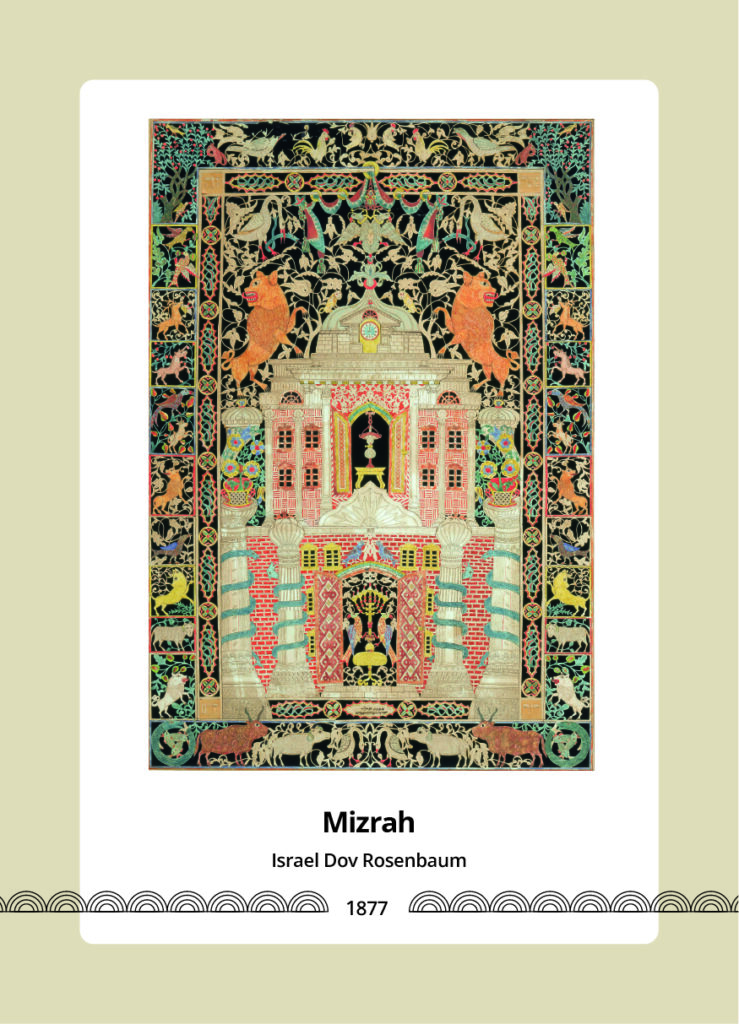
Mizrah, Israel Dov Rosenbaum, 1877
The Jewish Museum
A mizrah is a decorative plaque on the eastern walls of homes and synagogues that indicates the direction of worship. In Eastern Europe, mizrah plaques were often made out of cut paper. Israel Dov Rosenbaum, the creator of this papercut, included a clock at its dome, possibly a hint at his profession as a clockmaker to the local count in the small town of Podkamen, Ukraine. A Jewish community existed in Podkamen at least since the seventeenth century, and by the late nineteenth century, the town was home to more than a thousand Jews.
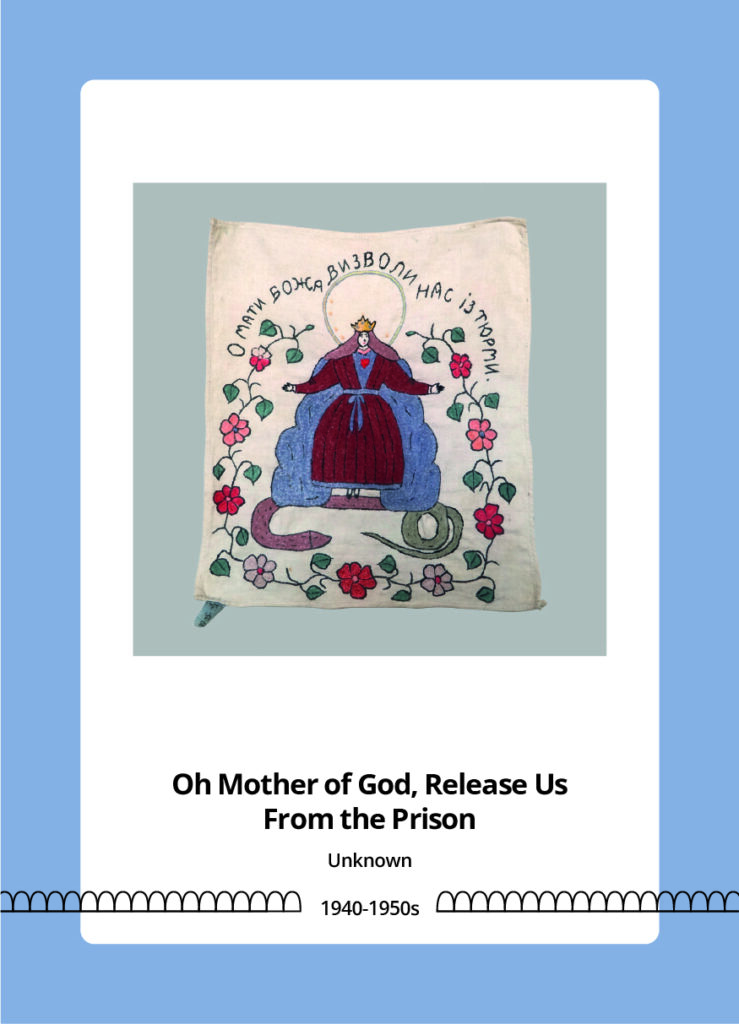
“Oh God Mother, release us from the prison”, Unknown, 1940-1950s
After World War II, many Ukrainians were deported and sent to Gulag camps, especially in the western part of Ukraine. Far from home, Ukrainians tried to preserve their traditions even in prison. Embroidery supported those in captivity. They embroidered icons and amulets, and also told about their experiences in prison in embroidery. They made needles themselves – from fish bones, and used threads from old things. For political prisoners and repressed people, embroidery became a way to preserve national identity, resist despair, and convey a message of freedom.
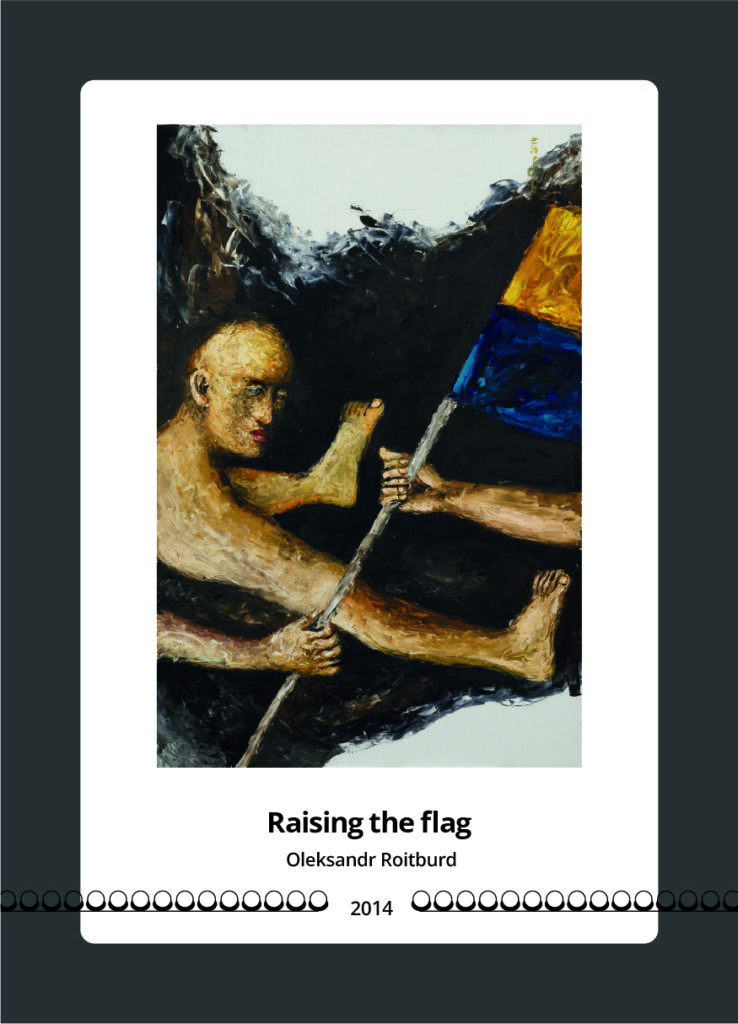
Raising the flag, Oleksandr Roitburd, 2014
The National Museum of the Revolution of Dignity
In November 2013, a peaceful protest in Kyiv against the failure to sign the agreement with the EU was brutally dispersed. After that, the protests grew into resistance to the authoritarian regime and politics of Russification. Millions of people were protesting across Ukraine.
“Raising the Flag” is a landmark painting by the prominent Ukrainian artist Oleksandr Roitburd, painted on the night of February 20-21, 2014, during the shootings of protesters on Independence Square in Kyiv. The participants of the Revolution of Dignity, who were killed by the security officers and their mercenaries, were given the name of the Heavenly Hundred.
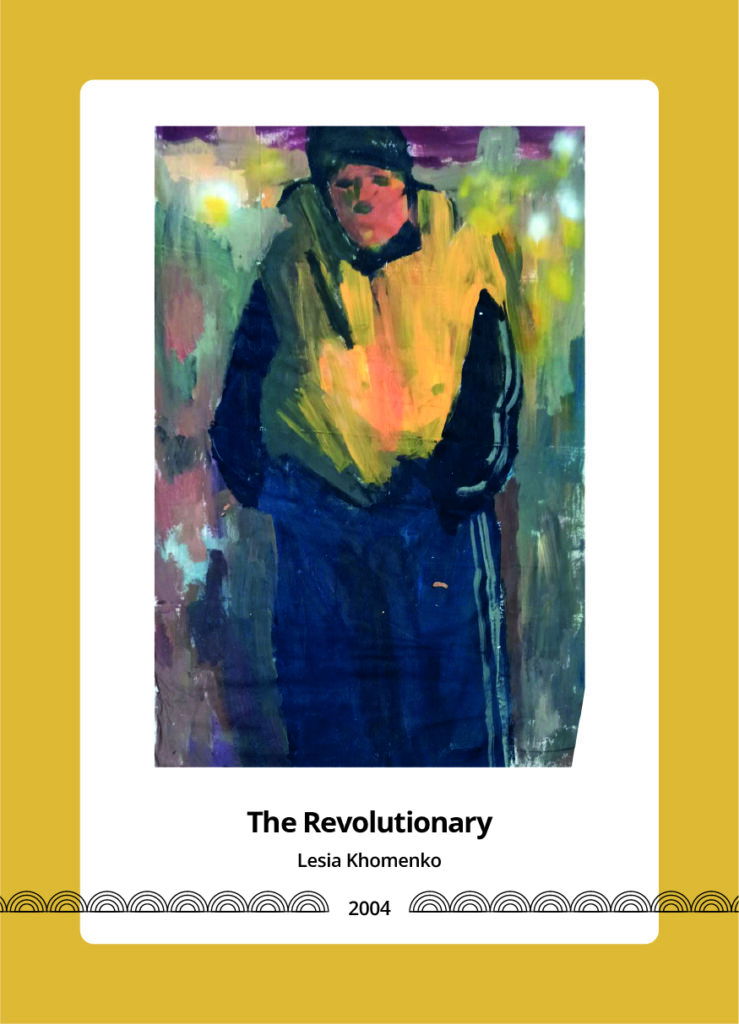
The Revolutionary, Lesia Khomenko, 2004
In 2004, during the Orange Revolution, which began as a protest against the falsified results of the presidential election, a new generation of young Ukrainian artists emerged. In Kyiv, among them was the Revolutionary Experimental Space, or R.E.P. association. Lesya Khomenko was one of the participants. In her portraits of protestors, the artist wanted to create an image of a modern hero, contrasting the depiction of the figure with the heroic figures of socialist realism. Khomenko’s heroes of the Orange Revolution were ordinary, everyday, but their monumental size immediately made their figures historical.
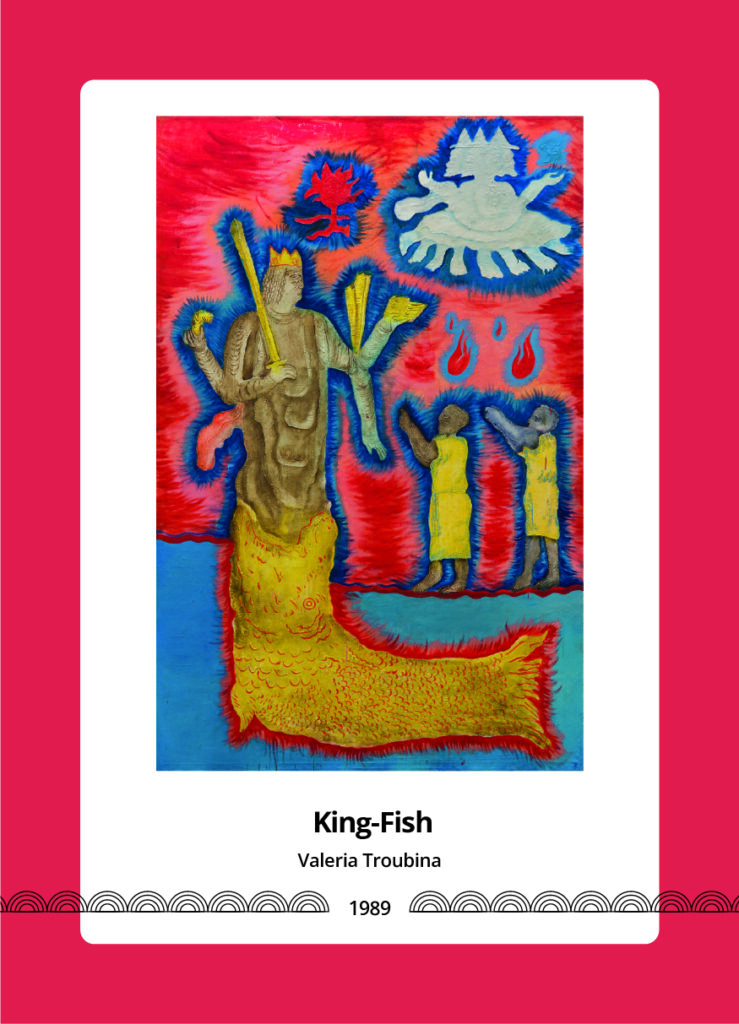
Valeria Troubina, King-Fish, oil on canvas, 1989
National Art Museum of Ukraine
Valeria Troubina belongs to the artists’ circle of the Ukrainian transavant-garde art of the new wave. She was part of the Parkomuna skvot art group based in Kyiv. After the Chornobyl catastrophe in 1986, many things in Ukraine changed. The Soviet system was to blame, and no one could hide it. As new political movements for Ukrainian independence began, the new postmodern art emerged after the nuclear catastrophe, creating new worlds on the canvases. They escaped reality both in art and personal life.
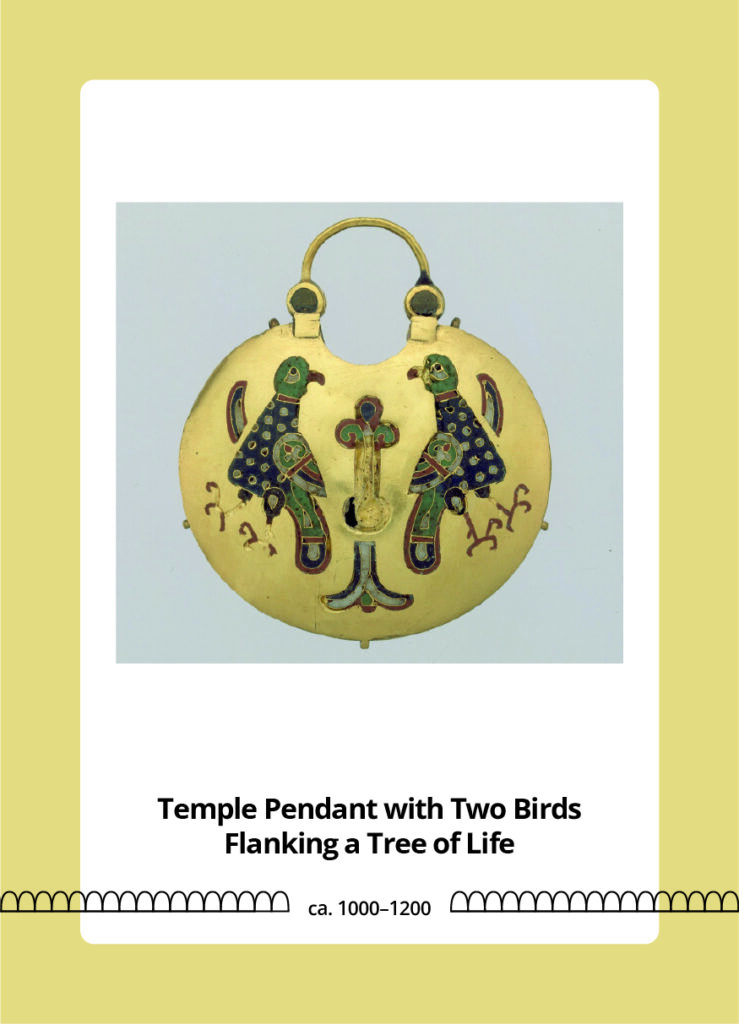
“Temple Pendant with Two Birds Flanking a Tree of Life
c.a. 1000–1200
Metropolitan Museum of Arts
By marrying the sister of the Byzantine emperors, Anna, and accepting Christianity as the official religion of Kyivan Rus in 988, Volodymyr the Great significantly raised its international authority and expanded economic and cultural ties with many European countries. The aristocracy also adopted the manners and dress of the Byzantine court, and local artists adopted the Byzantine style. The Tree of Life was, and still is, one of the most powerful symbols in Ukrainian art, especially in embroideries and peasant paintings and, later, in 1920, in the art of the Boichukists.
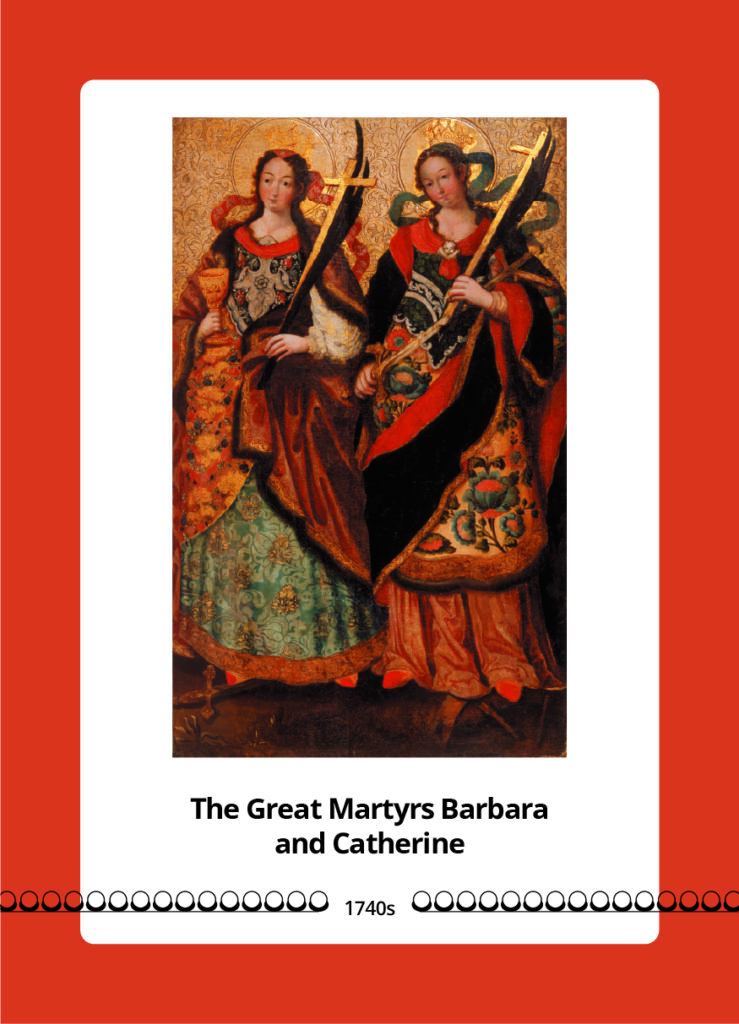
The Great Martyrs Barbara and Catherine, 1740s
National Art Museum of Ukraine
Ukrainian Baroque is called Cossack Baroque, as the style developed during the time of the Hetmanate, the Ukrainian Cossack state, and it was Cossacks who were the bearers of a new artistic taste. Popular in architecture and art, the style arose as a synthesis of Western European Baroque influences, the ancient traditions of Kyivan Rus, and folk Ukrainian art. On Baroque icons, we see the bright clothes of the nobility of that time, where elegant floral ornament, embroidered with silver and gold, was in fashion.
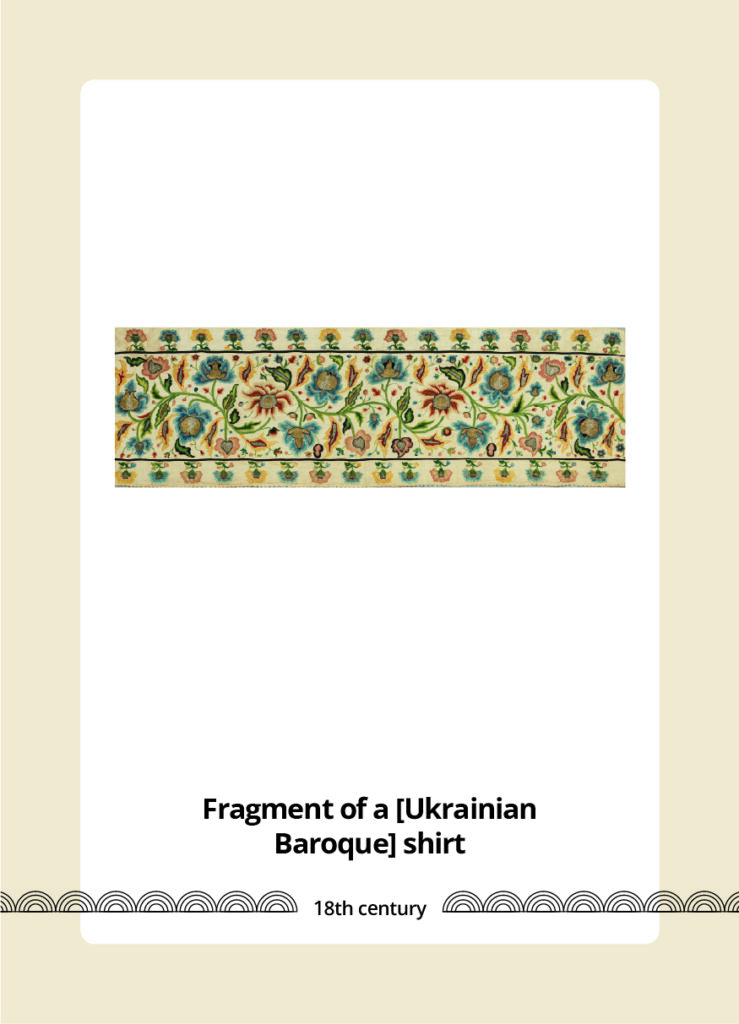
Fragment of a [Ukrainian Baroque] shirt, 18th century
Metropolitan Museum of Arts
The first Ukrainian female artists were embroiderers. They often worked in monastery workshops and embroidered clothes for priests and other items for ritual purposes. Over time, embroidery became fashionable among secular circles, and intricate decoration appeared on painted Baroque icons. This embroidery is also called “hapty”. Hapty are cult and secular products embroidered with metallic gold and silver threads. This technique has been known in Ukraine since the 12th century. This floral ornament has survived the centuries – later similar flowers can be seen in modernism.
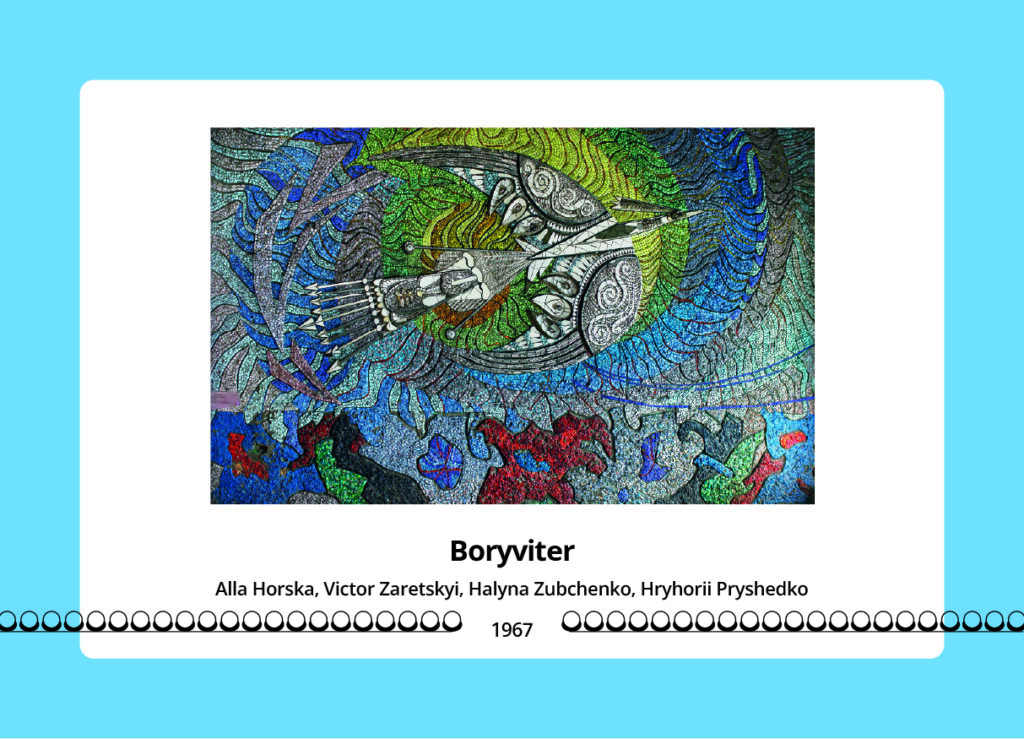
Boryviter, Alla Horska, Victor Zaretskyi, Halyna Zubchenko, Hryhorii Pryshedko, 1967
After the repressions of the 1930s, Ukrainian art plunged into socialist realism for a long time. But in the 1960s, a new generation emerged, basing its art on the traditions of Boychukism and folk art. But repression and imprisonment came after this generation as well. In 1970, dissident, artist, and one of the leaders of the Sixties movement, Alla Horska, was killed by the KGB for her art and political position. The Boryviter mosaic in Mariupol was destroyed by Russian shelling in 2022. Now this mosaic is a symbol not only of the Sixties movement, but also of today’s struggle of Ukrainians for their independence and identity.
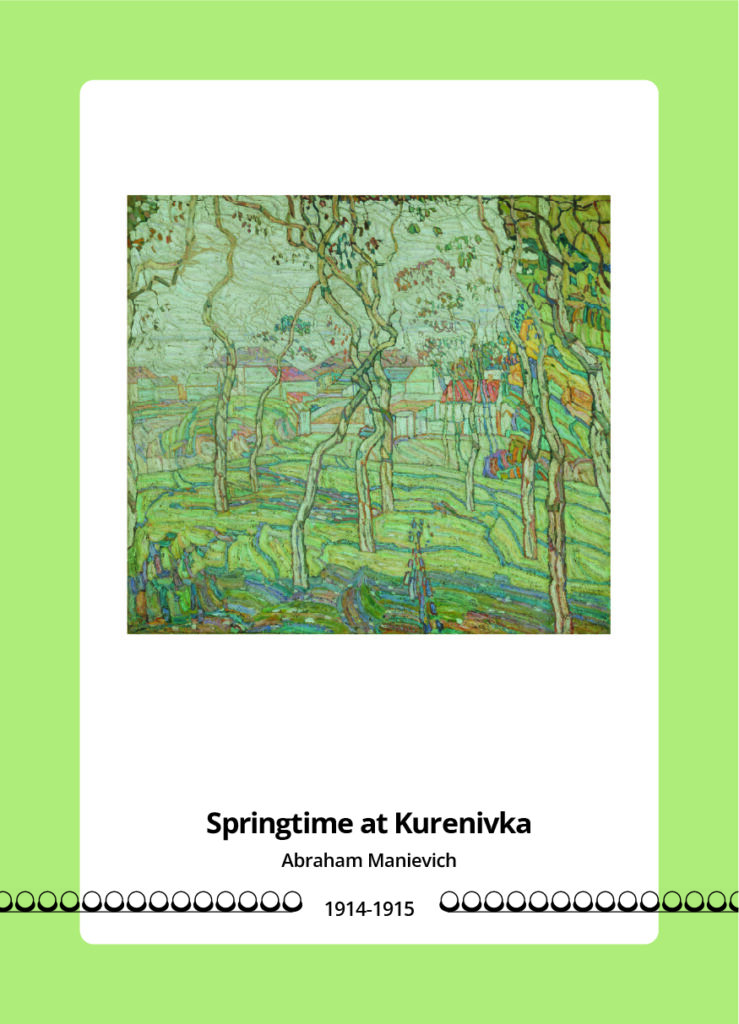
Springtime at Kurenivka, Abraham Manievich, 1914-1915
National Art Museum of Ukraine
Abraham Manievich was born in Belarus in a Jewish family, but Ukraine was his second motherland. He studied in Kyiv and Munich. In 1913, Manevich had a personal exhibition in Paris, which immediately made him a famous artist. But he still chose his homeland, which accepted him, and returned to Kyiv. In 1917, Manevich became one of the founders of the Ukrainian Academy of Arts. Together with his family, the artist emigrated in 1922 and settled in the Bronx, New York. Now the main characters of the landscapes are the streets of New York, Pittsburgh, and Philadelphia. However, the longing for his homeland did not leave Abram Manevich; he painted landscapes from memory. At the artist’s request, his daughter donated almost half a hundred works to the National Art Museum of Ukraine.