
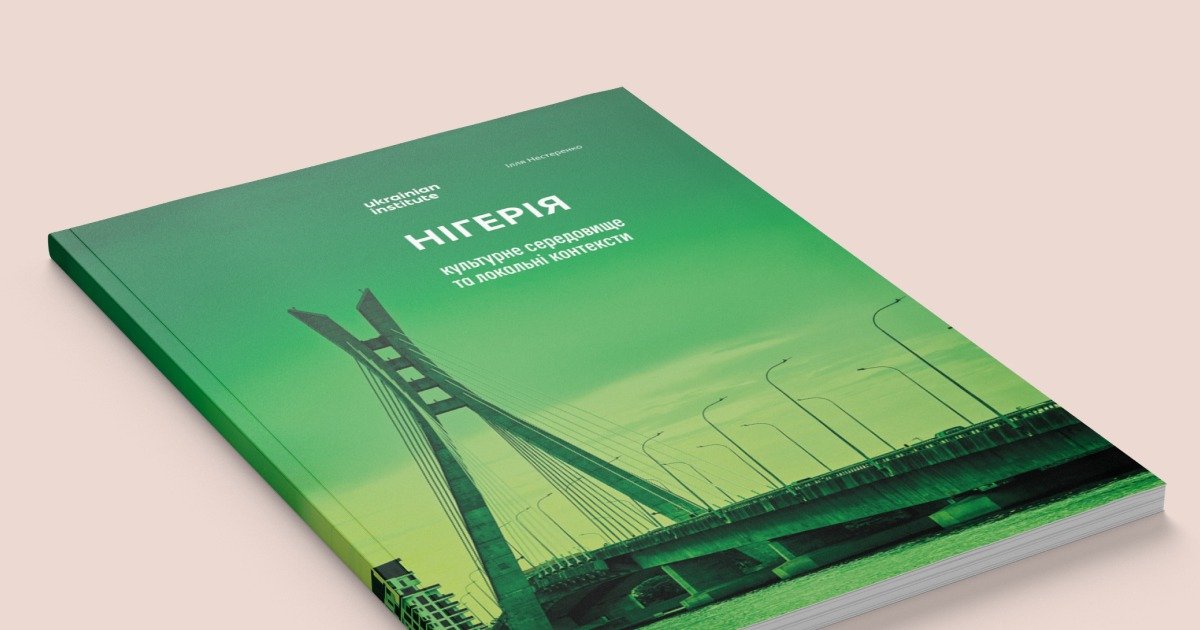

The research on cultural environment and local contexts in Nigeria is a part of the Ukrainian Institute’s comprehensive research project in Asia, Africa and Latin America countries.
The aim of the research is to identify and summarise data on the local cultural infrastructure, socio-political, historical and cultural contexts, matters of identity, indigenous peoples, other important local cultural phenomena, as well as sensitive topics and sociocultural occurrences in Nigeria.
17 experts participated in the field stage of the research, conducted in the form of semi-structured in-depth interviews. They covered members of the diplomatic corps and Ukrainian diaspora organisations, Nigerian representatives of cultural, scientific and art institutions, as well as media and civil society organisations in Nigeria.
The data obtained will create the basis for thorough and qualitative planning of directions, projects, and working formats for the Ukrainian Institute, representatives of the cultural sphere, and the diplomatic missions of Ukraine in Nigeria.
ADASTRA Think Tank
Duration
2024 – 2025
Author
Illia Nesterenko
Project manager
Bohdan Veselovskyi
Interviewer
Dmytro Suslyk
The official approach of the Nigerian federal government to cultural policy is based on the “unity in diversity” principle, which emphasises the development of a pan‑Nigerian cultural identity, and the cohesion of the federation. At the same time, particularism is widespread, and ethnic groups continue to compete for access to state resources. This situation is largely explained by the large number of ethnic groups in Nigeria and the country’s colonial history, which still influences culture and politics. Nigeria, with a population of 236 million as of 2024, is home to more than 250 ethnic groups speaking over 500 languages.
In modern Nigerian interpretations of colonial history, a predominantly negative perception of the colonial experience prevails alongside the acknowledgment of British influence on shaping of Nigerian culture and the post‑colonial political system. The engagement with “lost pieces of culture” is a common theme in colonial discourse. Colonisation resulted in the dispersal and loss of a vast number of pre‑colonial cultural artefacts. A notable trend in contemporary Nigerian culture is the movement to repatriate historical artefacts to their places of origin.
Controversial topics that require a balanced and sensitive approach fall into three groups: political (including periods of dictatorship, outbreaks of inter‑ethnic hostility and state’s responses to them, and the civil war in the Republic of Biafra), ethnic‑religious (encompassing the diversity of cultural traditions and religious values, which requires attention to traditional power structures and legal or social restrictions on certain religions and cultural practices), and stereotypical perceptions (negative stereotypes relating to crime, development, and national traditions).
Culture in Nigeria signifies more than heritage. It is also a powerful economic sector with a significant impact on national development. The Nigerian creative industries are among the most advanced in Africa, constituting the country’s second‑largest economic sector after agriculture. Despite their substantial contribution to the national economy, these industries are predominantly financed by private capital with the limited state support for culture because of constrained public budgets.
When asked about associations with Ukraine, most of the respondents mentioned education rather than the war. Xenophobic attitudes and negative experiences of some Nigerians in Ukraine are systematically amplified by Russians to inflate the narrative of a “racist government in Ukraine that hates Africans.” The topic of racism, whether perceived or real, frequently arose in conversations with respondents.
The prevailing trend in understanding Ukraine, its culture, and its history is a lack of knowledge beyond the war. Ukraine is generally perceived as a European country at war. Distinctive aspects of Ukraine, including its differences from Russia, often remain unknown.
At the same time, when planning cultural events in Nigeria and seeking foreign partners there, including other European cultural diplomacy institutions, it is essential to take into account that Ukraine is sometimes viewed unfavourably as an ally of the West.
Therefore, it is important to consider this perspective when working with Nigerians. Project activities that develop a Nigerian-facing narrative framing the Russian – Ukrainian war through the lens of colonialism are highly relevant: positioning Ukraine as a country resisting neocolonial expansion by its former metropolis and exposing the neocolonial nature of Russian foreign policy.
For more details on recommendations for Ukrainian – Nigerian cultural cooperation and potential challenges, please refer to the research in Ukrainian.
The research was implemented thanks to financial support from the International Renaissance Foundation as a part of the G55214 project “Strengthening Ukraine’s Voice in the World”, with the assistance of the Cultural Diplomacy Foundation NGO.